You can build a lo-fi anime YouTube channel with AI tools in 2026 and still get monetized — but only if you treat it as a creative brand, not a content factory. The channels winning right now use AI to assist their vision, not replace it. Here's everything I learned building mine.
I got obsessed with lo-fi anime channels about a year ago. I had them on loop while working, studying, coding at midnight. Then I thought — I could build one of these.
So I did. And I made almost every mistake possible.
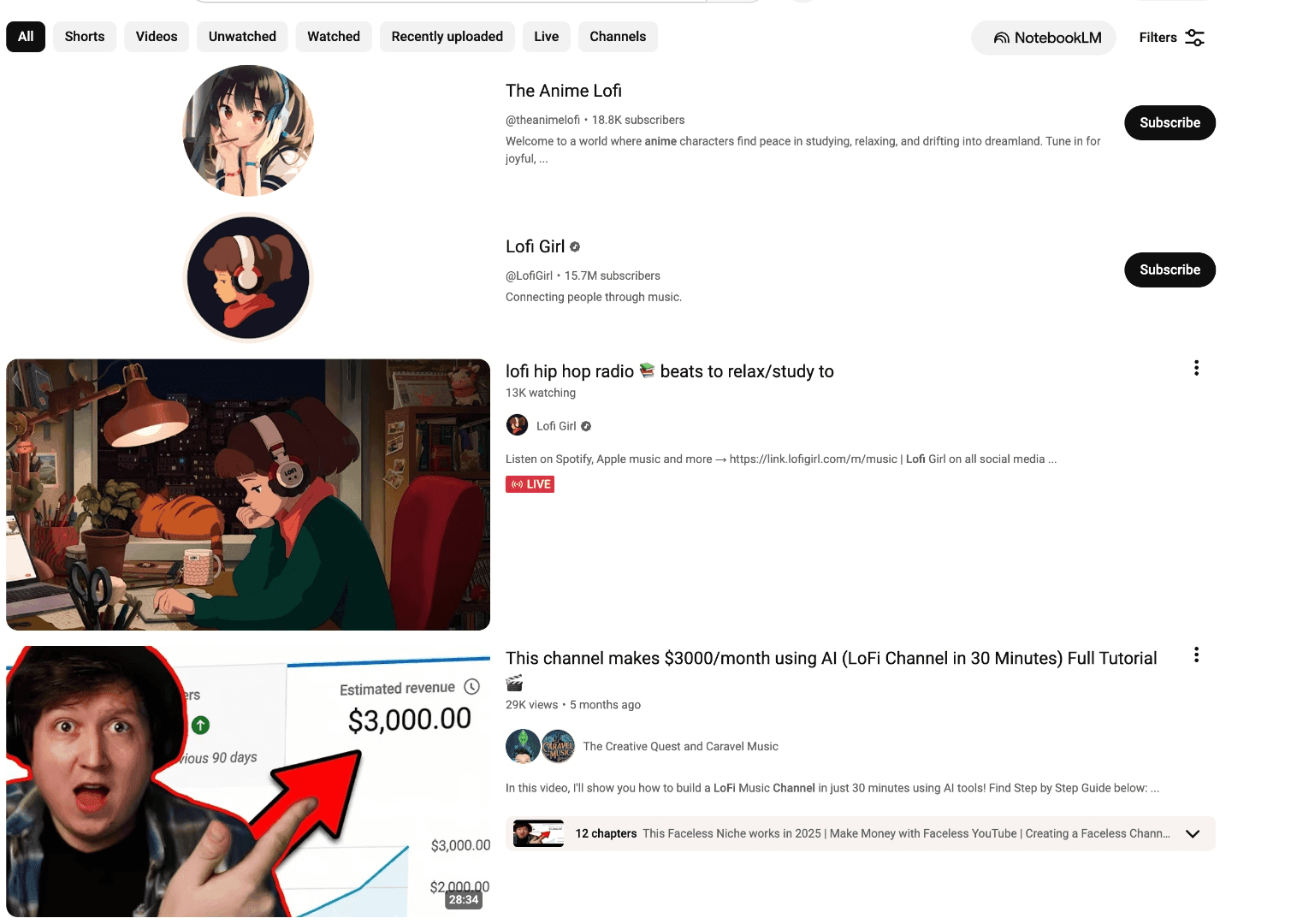
I kept seeing the same thing over and over: tutorials promising "full automation," channels pumping out videos daily, and then — silence. Demonetized. Removed. Gone. Meanwhile, a handful of channels with actual identity kept growing.
Here's the thing nobody tells you upfront: the landscape in 2026 is completely different from 2023. The "set it and forget it" era is over. YouTube's enforcement has teeth now. But — and this is the part worth paying attention to — AI-assisted channels with real human direction still have a clear path to the YouTube Partner Program.
By the end of this guide, you'll know exactly how to build a channel that looks original, sounds cozy, and has a real shot at monetization. No hype. No "passive income in 30 days" promises. Just what actually works.
What Makes a Lo-Fi Anime Channel Actually Work
Let me be direct: this is not about making pretty AI art. The real job-to-be-done is functional ambience. Something cozy enough to study, work, or sleep to. That's the promise your channel makes to every listener.
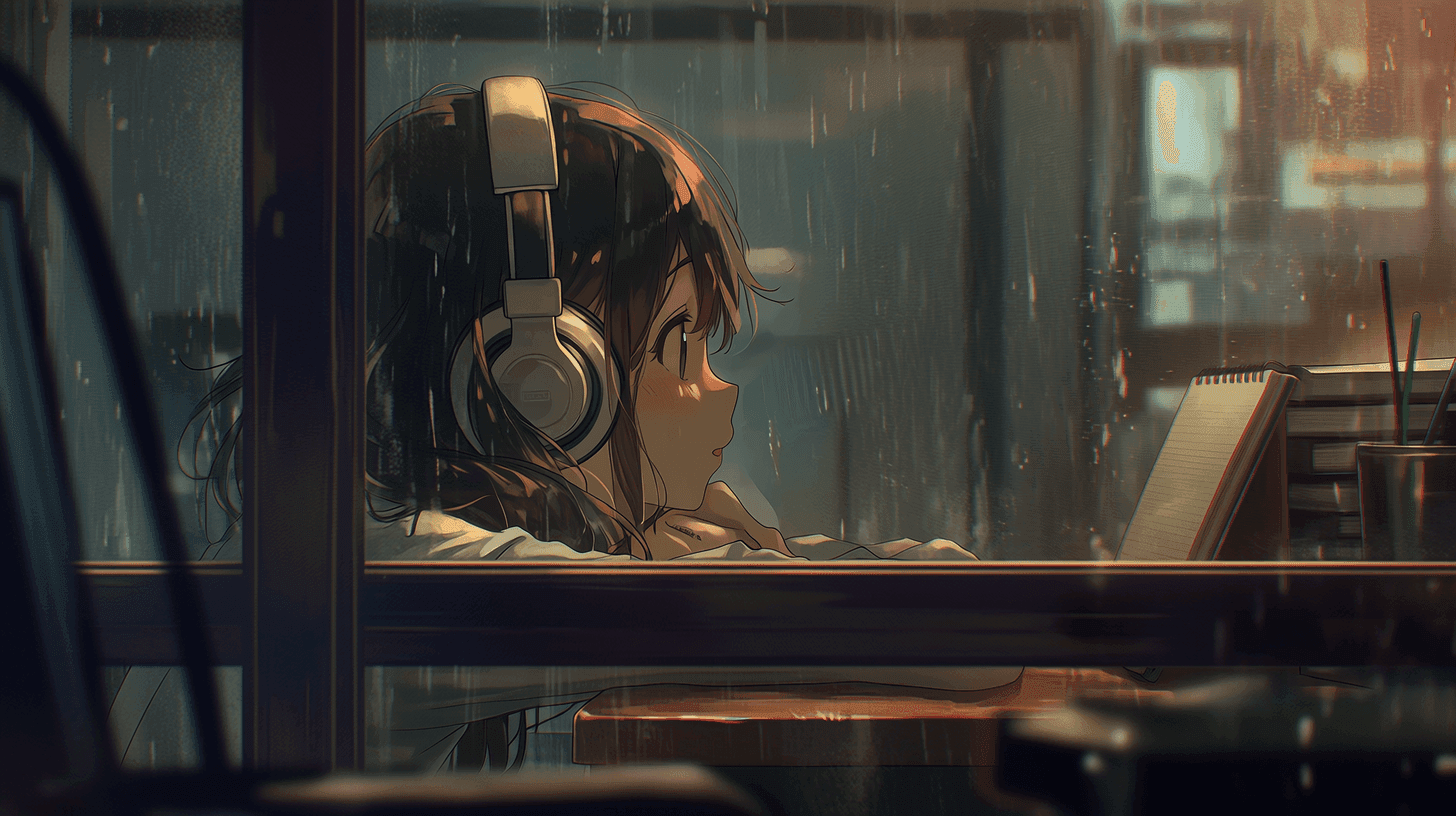
I kept seeing the same mistake over and over — creators focused entirely on aesthetics and ignored atmosphere. They'd generate a gorgeous anime girl at a desk, add a random beat, upload it, and wonder why nobody stayed.
The channels that actually grew had one thing in common: they built a world, not just a video library.
Think about what makes a great lo-fi channel feel different from a clone channel:
That's a channel world. And building one is how you avoid looking like "AI slop" to both the algorithm and your audience.
The real question isn't "how do I generate content faster?" It's "how do I make someone feel something when they hit play?"
The Honest Monetization Reality in 2026 (Don't Skip This)
I know you want to jump straight to the tools. But skipping this section is how channels get wiped. I've seen it happen. Some of them were mine.
What YouTube Actually Flags
Similar repetitive content with low educational value, minimal variation across videos, and mass-produced content using a similar template across multiple videos are explicitly not allowed to monetize.
That language maps almost perfectly to the "same room, different wallpaper" strategy that dominated lo-fi channels in 2023. It doesn't fly anymore.
The July 2025 Policy Rename
On July 15, 2025, YouTube made a minor update to rename its "repetitious content" policy to "inauthentic content." This type of content has always been ineligible for monetization — creators are rewarded for original and authentic content.
The name changed. The standard didn't. But the enforcement definitely did.
Why January 2026 Was a Wake-Up Call
16 major channels disappeared from the YouTube Partner Program — these weren't small accounts. They held 4.7 billion views and earned 10 million dollars in yearly revenue.
That's not a warning shot. That's a full enforcement wave.
The Good News
The YouTube AI policy update is not a ban on AI. It's a crackdown on mass-produced, inauthentic content. Creators who use AI thoughtfully and bring human perspective will continue to be monetizable.
AI is a tool. The problem was never the tool — it was the absence of authorship behind it.
YPP Thresholds (Quick Reference)
| Tier | Subscribers | Watch Hours / Shorts Views |
|---|---|---|
| Fan-funding / Shopping | 500 subs | 3,000 watch hours OR 3M Shorts views |
| Ad Revenue (Standard) | 1,000 subs | 4,000 watch hours OR 10M Shorts views |
The Key Insight
When a channel clearly has authorship, AI becomes an amplifier. When a channel has no authorship, AI becomes an exposure mechanism.
That line lives rent-free in my head. Authorship is your monetization armor.
How to Set Up Your Channel the Right Way (Before You Touch Any AI Tool)
Here's the exact way I structured my channel before uploading a single video — and what I'd do differently now.
Pick an Original Character, Not Borrowed IP
No lo-fi versions of famous anime characters. No borrowed mascots. Build an original anime-inspired OC (original character) from scratch. This protects you from copyright issues and from the "reused content" flag. Your character is your brand.
Think: anime-inspired study universe, not a knockoff of an existing franchise.
Create Your Channel Bible
Before you generate anything, write down:
This gives you brand consistency without triggering the "template repeated at scale" flag. Every video feels like the same world — but each one is meaningfully different.
Write Your About Page Like a Creator
Put your role in plain language: visual director, composer, animator, editor. YouTube reviewers look at your About page and channel description during monetization reviews. A channel that reads like a content farm gets treated like one.
Your Channel Name Is Your Brand
"Cozy Anime Beats Vol. 7" is not a brand. It's a placeholder. Your channel name should be ownable, memorable, and searchable. Think of it like naming a small studio, not a playlist.
The AI Tool Stack I'd Actually Use (Step-by-Step)
You don't need 15 tools. You need 4–5 that work together. Here's what I'd use if I were starting today.
Quick Tool Comparison
| Tool | Best For | Price | Lo-Fi Fit |
|---|---|---|---|
| Midjourney Niji 7 | Original anime character generation | From ~$10/mo | ⭐⭐⭐⭐⭐ |
| DomoAI | Anime animation & style transfer | From $9.99/mo | ⭐⭐⭐⭐⭐ |
| Suno Studio | Original lo-fi music generation | Free + paid | ⭐⭐⭐⭐ |
| CapCut / Premiere | Video assembly & ambience layering | Free / paid | ⭐⭐⭐⭐ |
🎨 Step 1 — Generate Your Original Character & Scene
Midjourney Niji 7 (launched January 9, 2026) is my first pick for this. It's built specifically for anime-coherent characters, and the prompt-following is noticeably better than earlier versions. Your character will actually look the way you described her.
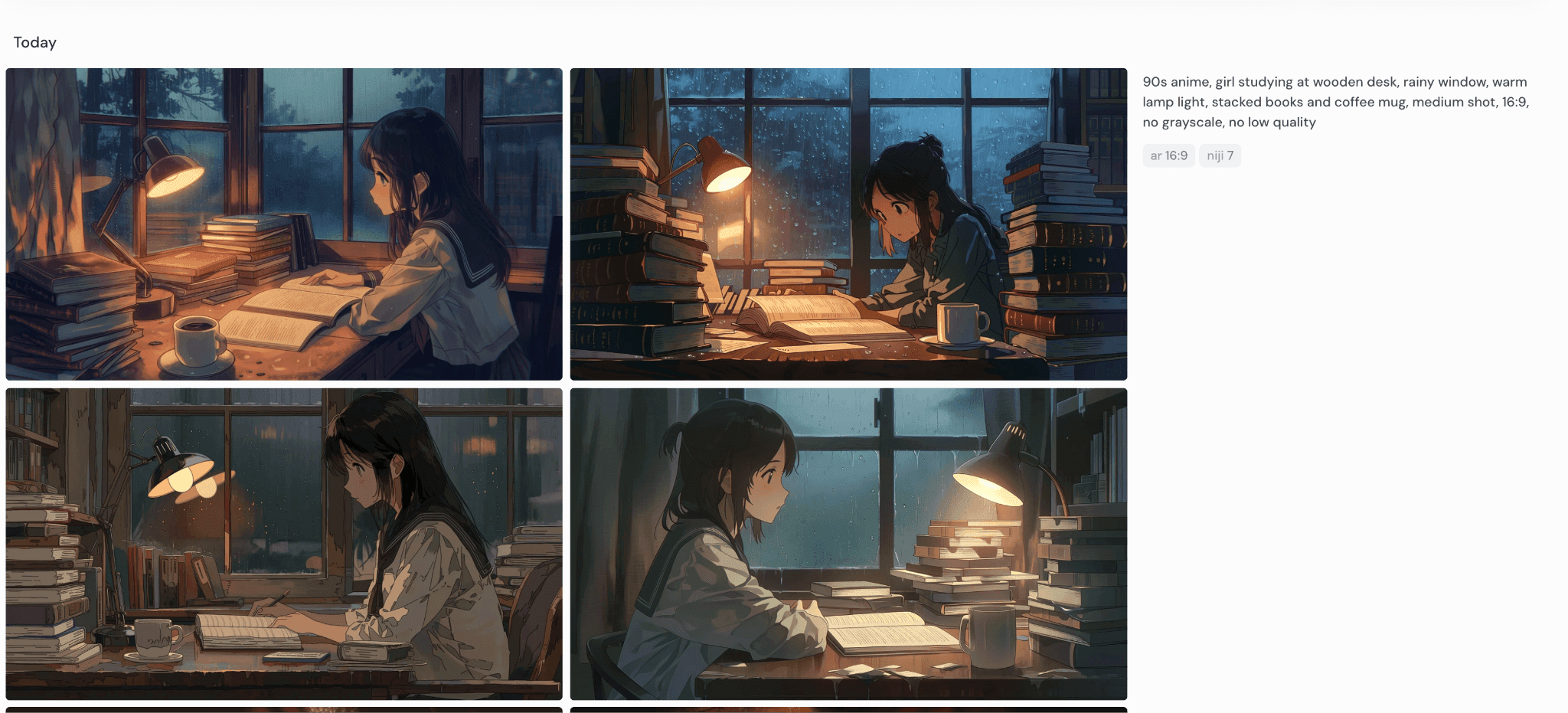
DomoAI is a strong alternative, especially for character consistency across uploads. You can use its own Text-to-Image model (12+ styles) or its built-in Nano Banana to create images.
Prompt formula that works:
[style] + [character + action] + [room/city environment] + [mood/light] + [props] + [camera framing] + [negative prompts]
Example:90s anime, girl studying at wooden desk, rainy window, warm lamp light, stacked books and coffee mug, medium shot, 16:9, no grayscale, no low quality
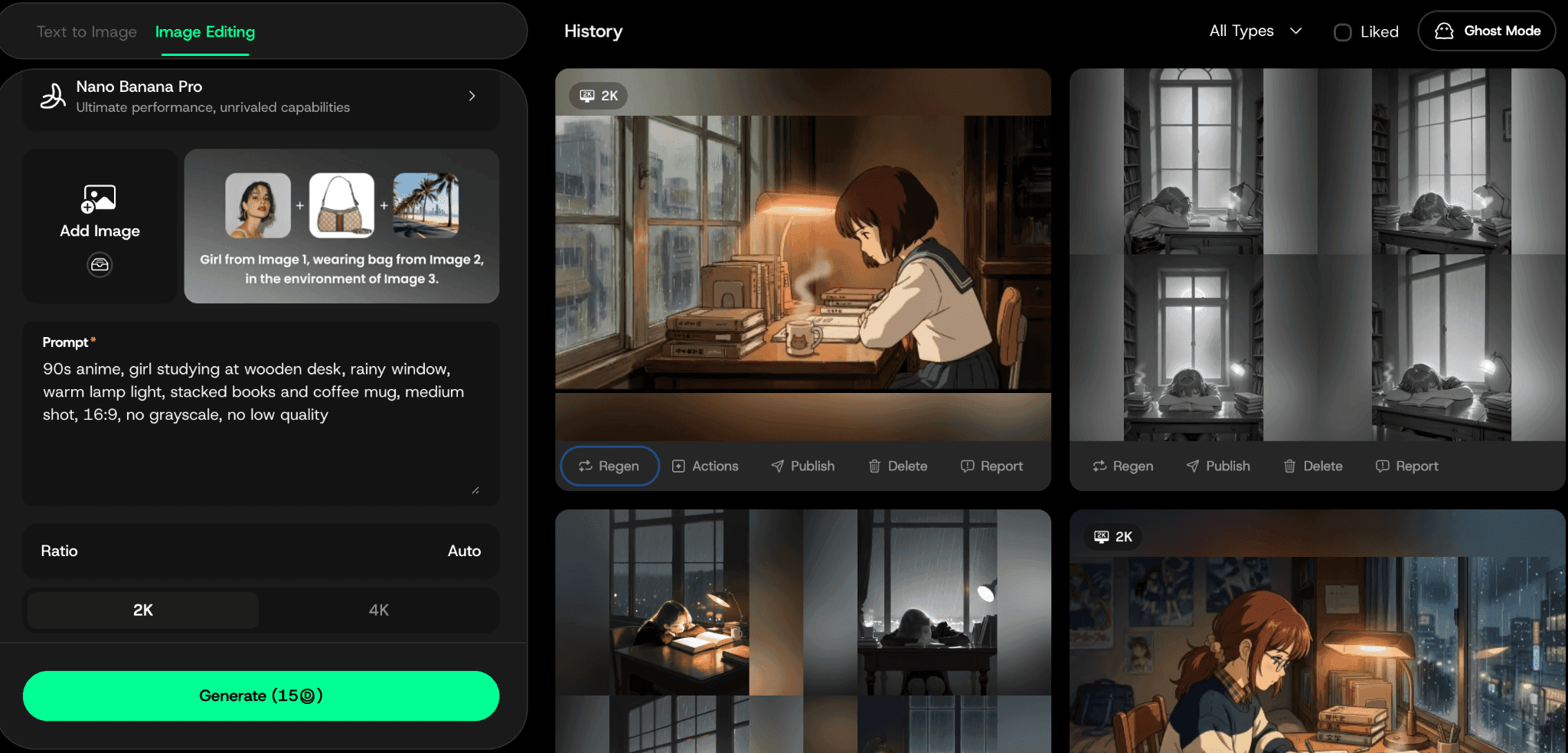
Don't copy public template prompts. That's how you end up looking like every other clone channel.
🎬 Step 2 — Animate Your Scenes with DomoAI
This is where I'd spend most of my time — and where DomoAI earns its spot in the stack.
While tools like Runway chase photorealism, DomoAI dominates stylized animation — it transforms videos into authentic anime masterpieces unlike any competitor.
For lo-fi channels specifically, the workflow I use is:
What really sets DomoAI apart is its comprehensive toolkit: text-to-video for initial concepts, image-to-video for bringing stills to life, and video-to-video for style transfers.
The feature that changes everything for this niche:
DomoAI's character consistency feature solves a major pain point — you can upload a character reference image and maintain features across all scenes.
That's huge. Keeping one anime OC consistent across dozens of videos is the #1 technical challenge in this niche. DomoAI handles it.
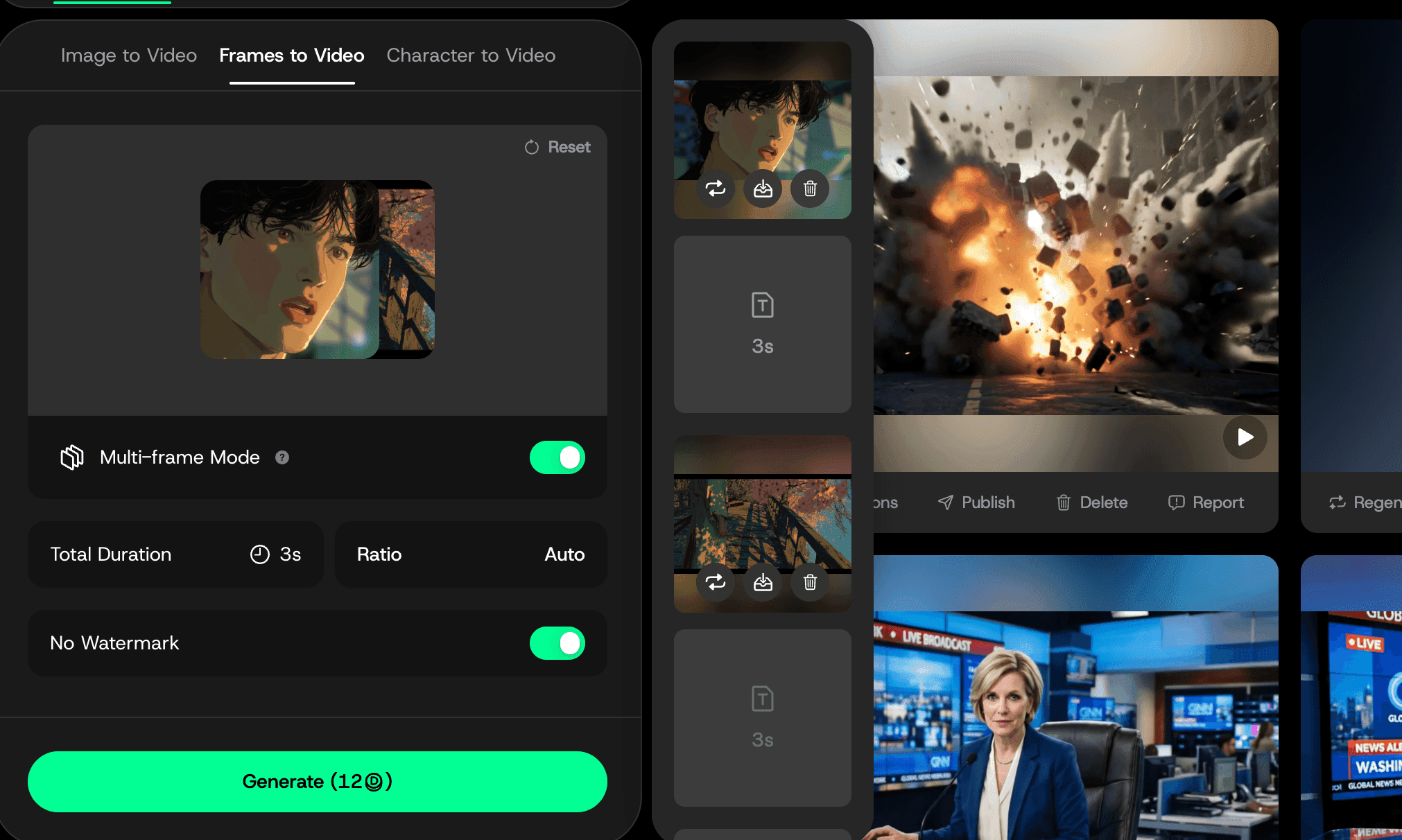
Frames to Video is the secret weapon:
The standout capability is Frames to Video: upload 2–8 keyframes and the AI generates smooth motion between each one. Your images become fixed anchor points, and the AI follows your lead rather than guessing at your vision.
Here's how I use it: I generate 3–4 keyframe images (character at desk → rain intensifies → character looks up → back to studying), upload them in sequence, and let DomoAI build the transitions. The result feels directed, not random.
Why it beats alternatives for this niche:
DomoAI shines in style consistency — unlike Pika, anime characters stay consistent frame-to-frame, and lines don't jitter, creating smooth motion.
Pricing:
Plans start at $9.99/month, with 4K output, text-to-video, image animation, lip sync, style transfer, and upscaling.
For a lo-fi channel at scale, I'd upgrade to the Standard plan ($27.99/month) for unlimited generations. That's cheaper than most competitors' basic tiers.
🎵 Step 3 — Create Original Music
This is the most overlooked trap in the entire niche. Music rights can kill your monetization even if your visuals are perfect.
Suno Studio (launched September 2025) positions itself as a generative audio workstation — more like a DAW than a one-click song generator. You can iterate on stems, adjust BPM, and build tracks that feel composed rather than generated. This is my go-to for original lo-fi beats.
Udio is worth mentioning, but with a caveat: following partnerships with major labels in late 2025, stem downloads were temporarily disabled. Before building your workflow around Udio exports, check their current licensing terms. This changes fast.
Best case: fully original or commissioned beats. Clean ownership = cleanest path to monetization.
Avoid this completely: Collections of songs from different artists, even if you have their permission, are explicitly listed as not allowed to monetize.
The old "curated lo-fi playlist" model is a monetization trap. Don't build on it.
🛠️ Step 4 — Assemble & Package Your Video
Live stream caveat: Watch time accumulates fast, but a repetitive looping stream with unclear music ownership is exactly the kind of content that flags as inauthentic. If you stream, stream your original world.
📱 Step 5 — Build Process Content (Shorts)
This is the most underrated step I almost skipped entirely.
Make Shorts showing your prompt iteration, your room build, your beat-making process, your character design decisions. Post them alongside your main videos.
These aren't just content — they're monetization evidence. If you ever face a reused-content review, a library of process Shorts showing exactly how you made each video is your strongest defense.
Think of it this way: every process Short is a timestamp proving you made this.
The 5 Mistakes That Will Get Your Channel Flagged
I've seen creators make all five of these mistakes. Some of them were me.
1. Uploading "same room, different wallpaper" at scale
This maps almost exactly to YouTube's "template repeated at scale" language. If your videos are only slightly different from each other, you're in the danger zone — regardless of how many you upload.
2. Using actual anime footage or famous characters
Copyright + reused content = double risk. Build original IP. Full stop.
3. Making both visuals AND music look obviously AI
Community trust collapses when both layers feel synthetic. If your visuals scream AI, your audience will assume your music is fake too — and they'll say so in the comments. Brand around one layer being clearly original.
4. Acting like a playlist curator
Collections of other artists' songs are a monetization trap even with permission. You need to own or clearly license your music.
5. Fully automating without any proof of authorship
YouTube recommends video appeals — specifically unlisted videos under five minutes explaining what changes the creator has made. A video appeal tends to be more effective than a text-only submission because it demonstrates exactly the kind of human involvement the policy requires.
Save your prompts. Save your project files. Save everything. If you get flagged, you want receipts.
What a Monetization-Safe 90-Day Upload Plan Looks Like
If I were starting from zero today, here's what my first 90 days would look like.
Month 1 — Build the World (Not Just Videos)
Goal: establish a clear brand identity before scaling anything.
Month 2 — Vary the Mood, Grow the Brand
Goal: demonstrate meaningful variation across uploads.
Month 3 — Apply for YPP
YouTube Monetization Rules 2026 require more than reaching subscriber and watch-time thresholds — you must create original content, disclose AI-generated elements when required, follow advertiser-friendly guidelines, and maintain clean traffic sources. Monetization now depends on full-channel compliance, not just performance metrics.
Goal: apply with a channel that reads like a creator brand, not a content farm.
Conclusion
I'm not going to tell you this is easy. It's not. Building a lo-fi anime channel with AI in 2026 takes real creative direction, consistent variation, clean music ownership, and enough process documentation to prove you made it.
But here's what I'll say: the "full automation" era is over, and that's actually good news for creators who care. The channels winning right now are AI-assisted, not AI-replaced — original characters, clear music ownership, visible human direction, meaningful variation between uploads.
The clone channels are getting squeezed. The authored ones are growing.
I'm not going to pretend this is easy. But I will say — there's nothing quite like the first comment that says "I've had this on loop for 3 hours." That's worth doing it right.
If you're building a channel, drop it in the comments. Ask a question. Bookmark this guide and come back when you hit Month 3. I'd love to see what you build.
FAQ
Q1: Can I monetize a YouTube channel that uses AI-generated visuals?
Yes. AI-generated videos are allowed if they are original, valuable, and comply with YPP rules. Purely automated, repetitive AI content may not be eligible for monetization. The key word is original. Use AI as a production tool, not a replacement for creative direction.
Q2: Is DomoAI good for lo-fi anime channels specifically?
It's one of the best tools for this exact use case. DomoAI specializes in transformations that other tools can't match, especially its signature anime styles that creators love. The character consistency feature is especially valuable when you need the same anime OC to appear across dozens of videos.
Q3: What's the difference between "reused content" and just using AI?
AI is a tool. Reused content is material. But creativity must be yours. You can use AI in your production — what YouTube penalizes is the absence of original human creative direction.
Q4: Do I have to disclose that my lo-fi visuals are AI-generated?
For anime-style/clearly animated content, disclosure is more about building audience trust than a strict policy requirement. YouTube's disclosure rules apply mainly to realistic synthetic content that could be mistaken for real people, places, or events. Anime-style lo-fi visuals typically fall outside that threshold — but being transparent with your audience is always good for brand trust.
Q5: What happens if my channel gets flagged for inauthentic content?
After demonetization, creators can reapply for YPP after a standard 30-day waiting period. Severe violations extend that window to 90 days. YouTube AI monetization rules require that any reapplication demonstrate a clear shift toward original, human-driven content.
Q6: Is the lo-fi anime niche too saturated to start in 2026?
The low-effort, clone-channel version of this niche is saturated and getting squeezed by policy enforcement. But there's a real opportunity gap for channels that feel authored — original characters, original music, a consistent world with its own identity. Don't use AI to manufacture content that any channel could publish with the same prompts, the same assets, and the same structure — because once your channel starts to feel interchangeable, the platform has very little reason to protect it.
Q7: What's the cheapest way to start this kind of channel?
You can start with Midjourney's basic plan, DomoAI's $9.99/month Basic Plan (500 credits, ~30 videos), and Suno's free tier for music drafts. As your channel grows, upgrade to DomoAI Standard ($27.99/month) for unlimited generations via Relax Mode. Everything runs in the browser — no expensive hardware needed.
Q8: Do 24/7 lo-fi live streams still work for building watch hours?
They can still help accumulate watch time toward YPP thresholds, but only if the stream reflects your original world — original visuals, original music, your branded OC. A repetitive looping stream with unclear music ownership is exactly the kind of content that flags as inauthentic under current policy. . Based on the available links from the sitemap.