Table of Content
Turn any text, image, or video into anime, realistic, or artistic videos. Over 30 unique styles available.
.tg {border-collapse:collapse;border-spacing:0;}
.tg td{border-color:black;border-style:solid;border-width:1px;font-family:Arial, sans-serif;font-size:14px;overflow:hidden;padding:10px 5px;word-break:normal;color:black;}
.tg th{border-color:black;border-style:solid;border-width:1px;font-family:Arial, sans-serif;font-size:14px;font-weight:normal;overflow:hidden;padding:10px 5px;word-break:normal;color:black;}
.tg .tg-amwm{font-weight:bold;text-align:center;vertical-align:top;}
.tg .tg-0lax{text-align:left;vertical-align:top;}
I've spent the last few months testing every AI music video tool I could get my hands on, and here's the truth — there is no single best AI music video generator for everyone. As of March 2026, the right pick depends on your budget, your music style, and how much creative control you want.
What makes an AI music video generator different from a generic AI video tool? It comes down to music-native features. I'm talking about audio-reactive visuals that pulse with your beat, automatic lyric sync, stem separation, and visual style consistency across a full three-minute track. A generic video tool can make pretty clips. A music video tool understands your song.
Here's what you'll get in this post: a ranked list of 7 tools I actually tested, who each one is best for, real pricing, and honest weaknesses. No fluff, no spec sheets. Let's get into it.
ToolBest ForStarting PriceKey StrengthNeural FramesOverall best for musicians$26/monthMusic-native, 8-stem audio reactivityRunwayCinematic/director-style$12/monthGen-4.5, Act-Two performance captureDomoAIStylized/anime visuals (Suno + DomoAI workflow)$9.99/month50+ V2V styles, talking avatar, anime modelsGoogle Flow + Veo 3.1Native audio realism$19.99/month (AI Pro)Audio-video co-generationKaiber SuperstudioCreative sandbox$29/monthMulti-model hub, audio-reactive flipbookRotor VideosFast, cheap promo assets~$9/videoAuto-cut to music, 9M+ stock clipsSora 2ChatGPT/OpenAI users$0.10/sec (API)Storyboard workflow, stitching
This is my top pick because it's the most music-native product in the space. Neural Frames stands out as the only music video creation tool built specifically for musicians. It doesn't just generate video — it listens to your song and reacts to it. For most artists, that matters more than raw video quality.
Neural Frames gives you three creation modes. Autopilot takes your song file and generates a full video fast. The Frame-by-Frame Editor gives you DAW-like control over every visual beat. And the Text-to-Video Editor lets you use models like Kling, Seedance, and Runway inside its own timeline.
The standout feature is 8-stem audio reactivity. The tool separates your track into individual stems (vocals, drums, bass, etc.) and maps visual changes to each one. It also handles automatic lyric extraction and sync, character consistency, and 4K output. You keep full commercial rights on everything you generate.
Indie artists, electronic and psychedelic visuals, lyric videos, and Spotify Canvas loops.
If your priority is photoreal cinematic shots, Neural Frames isn't the strongest pick. It shines in music-reactive workflows, not Hollywood-style production. For that, look at Runway or Veo 3.1.
For most musicians reading this, Neural Frames is the answer. It understands your song instead of just generating generic clips. That's a real difference.
Runway is the strongest choice if you think like a filmmaker, not a musician. It's a professional production toolkit that happens to be great for music videos.
Runway is more of a general AI video platform. It has powerful generative video models and editing tools. The current lineup includes Gen-4.5 (its most advanced model), Aleph video editing, Act-Two performance capture, and access to Veo 3/3.1 inside the platform.
Act-Two is the feature that caught my attention for music videos. It supports up to 30 seconds and transfers a driving performance to a character with realistic motion, speech, and expression. Think: stylized band avatars or virtual performers that actually move like humans. Gen-4.5 supports 2–10 second shots at 720p.
Commercial usage rights are included on all plans.
Narrative videos, hybrid live-action plus AI, consistent character shots, performance-driven scenes, and stylized band avatars.
Clip lengths are still short, so longer music videos mean stitching multiple shots together. Credits burn fast when you're iterating on creative ideas. Musicians may find the workflow less intuitive than Neural Frames.
If you're a filmmaker making a music video, Runway is your tool. If you're a musician making a music video, start with Neural Frames and come here when you need cinematic shots.
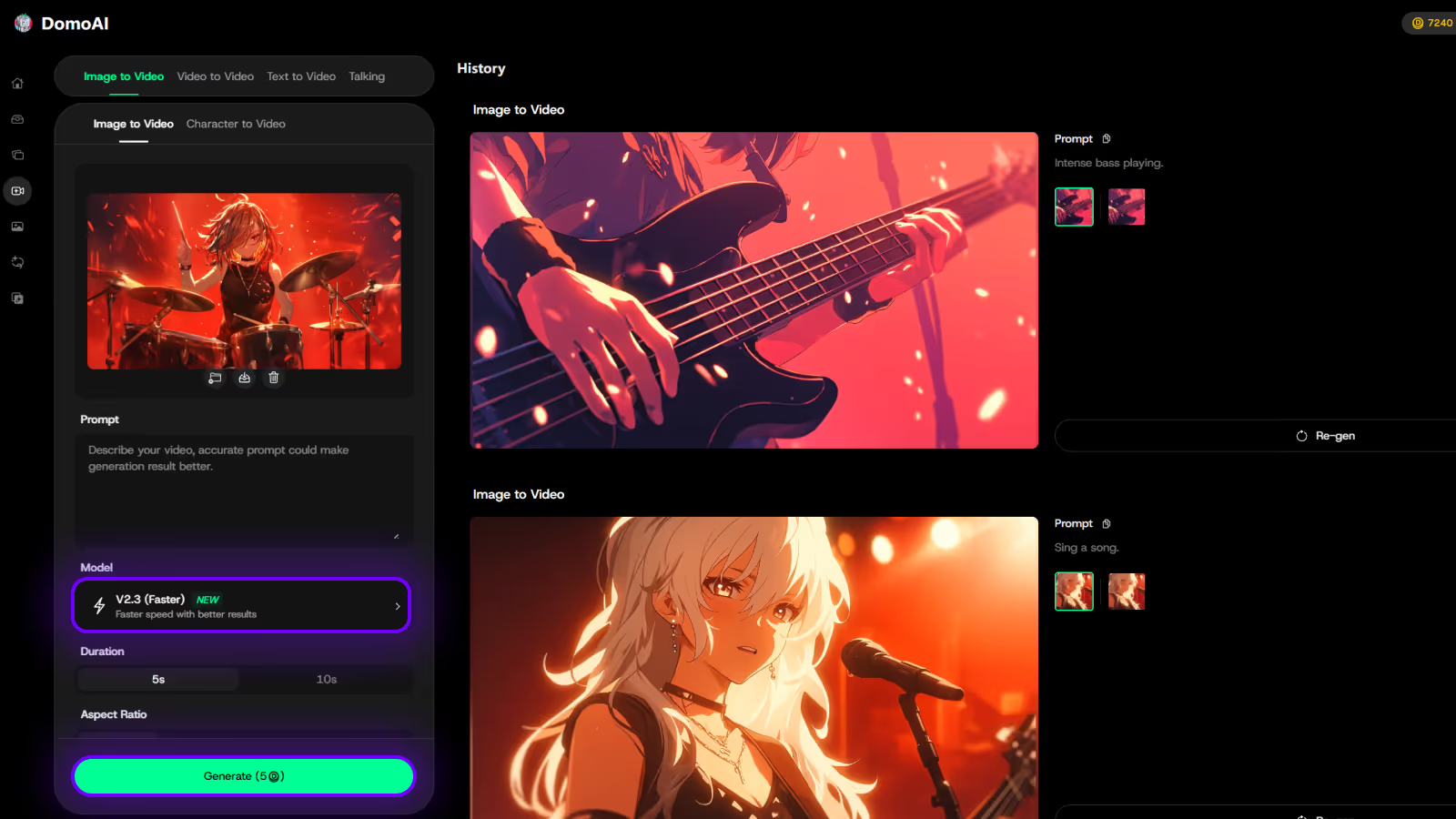
Here's a power move most people overlook: pair Suno (or Udio) for the music with DomoAI for the visuals. DomoAI doesn't generate music — let me be upfront about that. But it handles the visual half of the music video workflow better than most dedicated video tools, especially if you want anime, stylized, or avatar-driven aesthetics.
DomoAI is an AI-powered creative studio focused on video generation, animation, and visual style transformation. Here's what matters for music video creators:
Here's the step-by-step process I'd recommend:
Starting from $9.99/month (Basic Plan, 500 credits). Standard at $27.99/month and Pro at $69.99/month both include unlimited generations on Relax Mode. The annual plan comes with a 30% discount.
You fully own the content you create with DomoAI and can use it commercially.
Creators building AI music videos with stylized or anime visuals, virtual artist personas, AMV-style projects, and anyone who already uses Suno or Udio and needs a visual partner tool.
DomoAI does not generate music or handle audio-reactive syncing natively. You need to pair it with a music generation tool and do the audio-visual sync yourself in a separate editor. This is a workflow tool, not an all-in-one solution.
The Suno + DomoAI combo is genuinely one of the best-kept secrets in AI music video creation right now. The anime quality is top-tier, the talking avatar feature is unique at this price point, and $9.99/month makes it the cheapest entry on this list. You just need to be comfortable doing the sync step yourself.
If your priority is audio generated together with video — not layered on afterward — Google is one of the most serious options right now.
Flow is Google's creative studio for Veo, Imagen, and Gemini. Workflows include Ingredients to Video, image animation, object insert/remove, video extension, camera control, and Scenebuilder. The key differentiator is native audiovisual co-generation: the audio and video are created as a unified output.
Google acknowledges that natural, consistent spoken audio remains an active area of development. It's impressive but not fully solved.
High-end audiovisual shots, concept trailers, cinematic intros/outros.
Cost ramps up fast with many takes. Speech and audio quality are still improving.
Kaiber evolved from a single-style music video tool into a canvas-based multi-model studio. It's the Swiss Army knife of this list.
Superstudio integrates Veo, Kling, Luma, Runway, Minimax, plus Audioshake for audio. The Audio Reactive Flipbook syncs visuals to uploaded audio for up to 8 minutes. It also offers Image Lip Sync and Video Lip Sync features.
Experimental artists, mood-heavy visuals, and creators who want many models in one workspace.
Less opinionated than Neural Frames. You'll spend more time designing a workflow instead of just uploading a song and getting a strong first draft.
Rotor solves a real problem: "I need good-enough video assets for my release by Friday." That's it. And it does that well.
Rotor analyzes your song, auto-cuts video to the music, offers 150+ styles, audio-reactive effects, and access to 9 million+ stock clips. You get free unlimited watermarked previews and only pay when you download.
Output is 1080p. You own rights to the video, but cannot claim ownership of stock content in YouTube Content ID.
Indie musicians on a budget, release cycles, lyric videos, Spotify Canvas, social cutdowns.
Much less bespoke. This is a workflow product, not a frontier-model playground.
If you already pay for ChatGPT Pro and want video generation baked into your existing workflow, Sora 2 makes sense. Otherwise, it's not the most cost-effective music video tool.
Sora 2 is OpenAI's flagship video and audio model. It includes synced audio, a storyboard workflow, remixing, and stitching for longer sequences. You get 15-second videos broadly, 25-second storyboard videos for ChatGPT Pro users, and stitched outputs up to 60 seconds.
Prompt-heavy ideation, storyboard-first creators, OpenAI-centric workflows.
Less music-native than Neural Frames or Rotor. You do more of the "translate song into scenes" work yourself.
If you care about raw video quality benchmarks, Kling 3.0 currently leads the Artificial Analysis blind-preference text-to-video leaderboard, both with and without audio. That matters.
But I'm not making it my top purchase recommendation here. During my research, I couldn't reliably verify current official pricing, rights, or documentation from the official site. So I'd treat Kling as a benchmark leader and watchlist pick, not the safest buy recommendation from a due-diligence standpoint. I'd rather be honest about that than pretend I verified something I didn't.
If you force me to give one answer: Neural Frames is the best AI music video generator for most musicians in 2026.
It's not the absolute benchmark winner in raw generic video quality. But it's the best music-video product because the workflow is built around songs, stems, lyric sync, and artist use cases — not around general text-to-video demos.
For filmmakers, I'd pick Runway. For native-audio cinematic experimentation, Flow/Veo 3.1. For stylized visuals and anime aesthetics on a budget, DomoAI paired with Suno is a seriously underrated combo — the talking avatar feature alone opens up creative directions no other tool on this list matches at that price.
Pick the tool that fits your workflow, not the one with the flashiest demo reel. That's the real answer.
Some tools can. Neural Frames and Rotor take your audio file and generate a full video automatically. Others like Runway or DomoAI work better when you bring your own visual concepts and pair them with the music yourself. It depends on how much creative control you want.
Google Flow offers a free tier with daily credits, and Rotor lets you preview unlimited watermarked videos for free before paying to download. DomoAI also gives new users free bonus credits to test features. None of these give you unlimited high-quality output for free, but they're great for testing before you commit.
No. DomoAI does not generate music. It handles the visual side only. The best workflow is to generate your track in a music AI tool like Suno or Udio, then bring it into DomoAI to create the visuals using style transfer, image-to-video, or the talking avatar feature.
DomoAI at $9.99/month is the cheapest subscription option for ongoing use. Rotor is the cheapest per-project option if you only need a few videos per year. Neural Frames starts at $26/month but offers more music-specific features for the price.
Most tools on this list grant commercial usage rights on paid plans, including Neural Frames, Runway, Kaiber, and DomoAI. Always check the specific terms of each platform, especially around stock content (Rotor has a Content ID restriction on stock clips) and API usage.
Tools like Neural Frames and Kaiber have built-in audio-reactive features that automatically sync visuals to your beat and stems. For tools like DomoAI or Runway that don't have native audio sync, you generate your visual clips first and then sync them to your audio in a video editor like CapCut, Premiere, or DaVinci Resolve.
DomoAI is the strongest pick for anime-style music videos. Its 50+ video-to-video styles and dedicated anime models produce consistent, high-quality anime visuals. Kaiber also handles stylized and anime-adjacent looks well, and Neural Frames can produce psychedelic or abstract anime-influenced visuals.
Honestly, not if music videos are your only goal. Sora 2 is powerful but not music-native. You'd get better music-specific value from Neural Frames at $26/month or DomoAI at $9.99/month. ChatGPT Pro only makes sense if you already use it heavily for other work and want Sora as a bonus.
ToolBest ForStarting PriceKey StrengthNeural FramesOverall best for musicians$26/monthMusic-native, 8-stem audio reactivityRunwayCinematic/director-style$12/monthGen-4.5, Act-Two performance captureDomoAIStylized/anime visuals (Suno + DomoAI workflow)$9.99/month50+ V2V styles, talking avatar, anime modelsGoogle Flow + Veo 3.1Native audio realism$19.99/month (AI Pro)Audio-video co-generationKaiber SuperstudioCreative sandbox$29/monthMulti-model hub, audio-reactive flipbookRotor VideosFast, cheap promo assets~$9/videoAuto-cut to music, 9M+ stock clipsSora 2ChatGPT/OpenAI users$0.10/sec (API)Storyboard workflow, stitching
.tg {border-collapse:collapse;border-spacing:0;}
.tg td{border-color:black;border-style:solid;border-width:1px;font-family:Arial, sans-serif;font-size:14px;overflow:hidden;padding:10px 5px;word-break:normal;color:black;}
.tg th{border-color:black;border-style:solid;border-width:1px;font-family:Arial, sans-serif;font-size:14px;font-weight:normal;overflow:hidden;padding:10px 5px;word-break:normal;color:black;}
.tg .tg-amwm{font-weight:bold;text-align:center;vertical-align:top;}
.tg .tg-0lax{text-align:left;vertical-align:top;}
I've spent the last few months testing every AI music video tool I could get my hands on, and here's the truth — there is no single best AI music video generator for everyone. As of March 2026, the right pick depends on your budget, your music style, and how much creative control you want.
What makes an AI music video generator different from a generic AI video tool? It comes down to music-native features. I'm talking about audio-reactive visuals that pulse with your beat, automatic lyric sync, stem separation, and visual style consistency across a full three-minute track. A generic video tool can make pretty clips. A music video tool understands your song.
Here's what you'll get in this post: a ranked list of 7 tools I actually tested, who each one is best for, real pricing, and honest weaknesses. No fluff, no spec sheets. Let's get into it.
ToolBest ForStarting PriceKey StrengthNeural FramesOverall best for musicians$26/monthMusic-native, 8-stem audio reactivityRunwayCinematic/director-style$12/monthGen-4.5, Act-Two performance captureDomoAIStylized/anime visuals (Suno + DomoAI workflow)$9.99/month50+ V2V styles, talking avatar, anime modelsGoogle Flow + Veo 3.1Native audio realism$19.99/month (AI Pro)Audio-video co-generationKaiber SuperstudioCreative sandbox$29/monthMulti-model hub, audio-reactive flipbookRotor VideosFast, cheap promo assets~$9/videoAuto-cut to music, 9M+ stock clipsSora 2ChatGPT/OpenAI users$0.10/sec (API)Storyboard workflow, stitching
This is my top pick because it's the most music-native product in the space. Neural Frames stands out as the only music video creation tool built specifically for musicians. It doesn't just generate video — it listens to your song and reacts to it. For most artists, that matters more than raw video quality.
Neural Frames gives you three creation modes. Autopilot takes your song file and generates a full video fast. The Frame-by-Frame Editor gives you DAW-like control over every visual beat. And the Text-to-Video Editor lets you use models like Kling, Seedance, and Runway inside its own timeline.
The standout feature is 8-stem audio reactivity. The tool separates your track into individual stems (vocals, drums, bass, etc.) and maps visual changes to each one. It also handles automatic lyric extraction and sync, character consistency, and 4K output. You keep full commercial rights on everything you generate.
Indie artists, electronic and psychedelic visuals, lyric videos, and Spotify Canvas loops.
If your priority is photoreal cinematic shots, Neural Frames isn't the strongest pick. It shines in music-reactive workflows, not Hollywood-style production. For that, look at Runway or Veo 3.1.
For most musicians reading this, Neural Frames is the answer. It understands your song instead of just generating generic clips. That's a real difference.
Runway is the strongest choice if you think like a filmmaker, not a musician. It's a professional production toolkit that happens to be great for music videos.
Runway is more of a general AI video platform. It has powerful generative video models and editing tools. The current lineup includes Gen-4.5 (its most advanced model), Aleph video editing, Act-Two performance capture, and access to Veo 3/3.1 inside the platform.
Act-Two is the feature that caught my attention for music videos. It supports up to 30 seconds and transfers a driving performance to a character with realistic motion, speech, and expression. Think: stylized band avatars or virtual performers that actually move like humans. Gen-4.5 supports 2–10 second shots at 720p.
Commercial usage rights are included on all plans.
Narrative videos, hybrid live-action plus AI, consistent character shots, performance-driven scenes, and stylized band avatars.
Clip lengths are still short, so longer music videos mean stitching multiple shots together. Credits burn fast when you're iterating on creative ideas. Musicians may find the workflow less intuitive than Neural Frames.
If you're a filmmaker making a music video, Runway is your tool. If you're a musician making a music video, start with Neural Frames and come here when you need cinematic shots.
Here's a power move most people overlook: pair Suno (or Udio) for the music with DomoAI for the visuals. DomoAI doesn't generate music — let me be upfront about that. But it handles the visual half of the music video workflow better than most dedicated video tools, especially if you want anime, stylized, or avatar-driven aesthetics.
DomoAI is an AI-powered creative studio focused on video generation, animation, and visual style transformation. Here's what matters for music video creators:
Here's the step-by-step process I'd recommend:
Starting from $9.99/month (Basic Plan, 500 credits). Standard at $27.99/month and Pro at $69.99/month both include unlimited generations on Relax Mode. The annual plan comes with a 30% discount.
You fully own the content you create with DomoAI and can use it commercially.
Creators building AI music videos with stylized or anime visuals, virtual artist personas, AMV-style projects, and anyone who already uses Suno or Udio and needs a visual partner tool.
DomoAI does not generate music or handle audio-reactive syncing natively. You need to pair it with a music generation tool and do the audio-visual sync yourself in a separate editor. This is a workflow tool, not an all-in-one solution.
The Suno + DomoAI combo is genuinely one of the best-kept secrets in AI music video creation right now. The anime quality is top-tier, the talking avatar feature is unique at this price point, and $9.99/month makes it the cheapest entry on this list. You just need to be comfortable doing the sync step yourself.
If your priority is audio generated together with video — not layered on afterward — Google is one of the most serious options right now.
Flow is Google's creative studio for Veo, Imagen, and Gemini. Workflows include Ingredients to Video, image animation, object insert/remove, video extension, camera control, and Scenebuilder. The key differentiator is native audiovisual co-generation: the audio and video are created as a unified output.
Google acknowledges that natural, consistent spoken audio remains an active area of development. It's impressive but not fully solved.
High-end audiovisual shots, concept trailers, cinematic intros/outros.
Cost ramps up fast with many takes. Speech and audio quality are still improving.
Kaiber evolved from a single-style music video tool into a canvas-based multi-model studio. It's the Swiss Army knife of this list.
Superstudio integrates Veo, Kling, Luma, Runway, Minimax, plus Audioshake for audio. The Audio Reactive Flipbook syncs visuals to uploaded audio for up to 8 minutes. It also offers Image Lip Sync and Video Lip Sync features.
Experimental artists, mood-heavy visuals, and creators who want many models in one workspace.
Less opinionated than Neural Frames. You'll spend more time designing a workflow instead of just uploading a song and getting a strong first draft.
Rotor solves a real problem: "I need good-enough video assets for my release by Friday." That's it. And it does that well.
Rotor analyzes your song, auto-cuts video to the music, offers 150+ styles, audio-reactive effects, and access to 9 million+ stock clips. You get free unlimited watermarked previews and only pay when you download.
Output is 1080p. You own rights to the video, but cannot claim ownership of stock content in YouTube Content ID.
Indie musicians on a budget, release cycles, lyric videos, Spotify Canvas, social cutdowns.
Much less bespoke. This is a workflow product, not a frontier-model playground.
If you already pay for ChatGPT Pro and want video generation baked into your existing workflow, Sora 2 makes sense. Otherwise, it's not the most cost-effective music video tool.
Sora 2 is OpenAI's flagship video and audio model. It includes synced audio, a storyboard workflow, remixing, and stitching for longer sequences. You get 15-second videos broadly, 25-second storyboard videos for ChatGPT Pro users, and stitched outputs up to 60 seconds.
Prompt-heavy ideation, storyboard-first creators, OpenAI-centric workflows.
Less music-native than Neural Frames or Rotor. You do more of the "translate song into scenes" work yourself.
If you care about raw video quality benchmarks, Kling 3.0 currently leads the Artificial Analysis blind-preference text-to-video leaderboard, both with and without audio. That matters.
But I'm not making it my top purchase recommendation here. During my research, I couldn't reliably verify current official pricing, rights, or documentation from the official site. So I'd treat Kling as a benchmark leader and watchlist pick, not the safest buy recommendation from a due-diligence standpoint. I'd rather be honest about that than pretend I verified something I didn't.
If you force me to give one answer: Neural Frames is the best AI music video generator for most musicians in 2026.
It's not the absolute benchmark winner in raw generic video quality. But it's the best music-video product because the workflow is built around songs, stems, lyric sync, and artist use cases — not around general text-to-video demos.
For filmmakers, I'd pick Runway. For native-audio cinematic experimentation, Flow/Veo 3.1. For stylized visuals and anime aesthetics on a budget, DomoAI paired with Suno is a seriously underrated combo — the talking avatar feature alone opens up creative directions no other tool on this list matches at that price.
Pick the tool that fits your workflow, not the one with the flashiest demo reel. That's the real answer.
Some tools can. Neural Frames and Rotor take your audio file and generate a full video automatically. Others like Runway or DomoAI work better when you bring your own visual concepts and pair them with the music yourself. It depends on how much creative control you want.
Google Flow offers a free tier with daily credits, and Rotor lets you preview unlimited watermarked videos for free before paying to download. DomoAI also gives new users free bonus credits to test features. None of these give you unlimited high-quality output for free, but they're great for testing before you commit.
No. DomoAI does not generate music. It handles the visual side only. The best workflow is to generate your track in a music AI tool like Suno or Udio, then bring it into DomoAI to create the visuals using style transfer, image-to-video, or the talking avatar feature.
DomoAI at $9.99/month is the cheapest subscription option for ongoing use. Rotor is the cheapest per-project option if you only need a few videos per year. Neural Frames starts at $26/month but offers more music-specific features for the price.
Most tools on this list grant commercial usage rights on paid plans, including Neural Frames, Runway, Kaiber, and DomoAI. Always check the specific terms of each platform, especially around stock content (Rotor has a Content ID restriction on stock clips) and API usage.
Tools like Neural Frames and Kaiber have built-in audio-reactive features that automatically sync visuals to your beat and stems. For tools like DomoAI or Runway that don't have native audio sync, you generate your visual clips first and then sync them to your audio in a video editor like CapCut, Premiere, or DaVinci Resolve.
DomoAI is the strongest pick for anime-style music videos. Its 50+ video-to-video styles and dedicated anime models produce consistent, high-quality anime visuals. Kaiber also handles stylized and anime-adjacent looks well, and Neural Frames can produce psychedelic or abstract anime-influenced visuals.
Honestly, not if music videos are your only goal. Sora 2 is powerful but not music-native. You'd get better music-specific value from Neural Frames at $26/month or DomoAI at $9.99/month. ChatGPT Pro only makes sense if you already use it heavily for other work and want Sora as a bonus.
ToolBest ForStarting PriceKey StrengthNeural FramesOverall best for musicians$26/monthMusic-native, 8-stem audio reactivityRunwayCinematic/director-style$12/monthGen-4.5, Act-Two performance captureDomoAIStylized/anime visuals (Suno + DomoAI workflow)$9.99/month50+ V2V styles, talking avatar, anime modelsGoogle Flow + Veo 3.1Native audio realism$19.99/month (AI Pro)Audio-video co-generationKaiber SuperstudioCreative sandbox$29/monthMulti-model hub, audio-reactive flipbookRotor VideosFast, cheap promo assets~$9/videoAuto-cut to music, 9M+ stock clipsSora 2ChatGPT/OpenAI users$0.10/sec (API)Storyboard workflow, stitching
.tg {border-collapse:collapse;border-spacing:0;}
.tg td{border-color:black;border-style:solid;border-width:1px;font-family:Arial, sans-serif;font-size:14px;overflow:hidden;padding:10px 5px;word-break:normal;color:black;}
.tg th{border-color:black;border-style:solid;border-width:1px;font-family:Arial, sans-serif;font-size:14px;font-weight:normal;overflow:hidden;padding:10px 5px;word-break:normal;color:black;}
.tg .tg-amwm{font-weight:bold;text-align:center;vertical-align:top;}
.tg .tg-0lax{text-align:left;vertical-align:top;}
I've spent the last few months testing every AI music video tool I could get my hands on, and here's the truth — there is no single best AI music video generator for everyone. As of March 2026, the right pick depends on your budget, your music style, and how much creative control you want.
What makes an AI music video generator different from a generic AI video tool? It comes down to music-native features. I'm talking about audio-reactive visuals that pulse with your beat, automatic lyric sync, stem separation, and visual style consistency across a full three-minute track. A generic video tool can make pretty clips. A music video tool understands your song.
Here's what you'll get in this post: a ranked list of 7 tools I actually tested, who each one is best for, real pricing, and honest weaknesses. No fluff, no spec sheets. Let's get into it.
[Suggested visual: Hero image — split-screen collage showing anime, cinematic, and abstract visual styles from different tools]
ToolBest ForStarting PriceKey StrengthNeural FramesOverall best for musicians$26/monthMusic-native, 8-stem audio reactivityRunwayCinematic/director-style$12/monthGen-4.5, Act-Two performance captureDomoAIStylized/anime visuals (Suno + DomoAI workflow)$9.99/month50+ V2V styles, talking avatar, anime modelsGoogle Flow + Veo 3.1Native audio realism$19.99/month (AI Pro)Audio-video co-generationKaiber SuperstudioCreative sandbox$29/monthMulti-model hub, audio-reactive flipbookRotor VideosFast, cheap promo assets~$9/videoAuto-cut to music, 9M+ stock clipsSora 2ChatGPT/OpenAI users$0.10/sec (API)Storyboard workflow, stitching
This is my top pick because it's the most music-native product in the space. Neural Frames stands out as the only music video creation tool built specifically for musicians. It doesn't just generate video — it listens to your song and reacts to it. For most artists, that matters more than raw video quality.
Neural Frames gives you three creation modes. Autopilot takes your song file and generates a full video fast. The Frame-by-Frame Editor gives you DAW-like control over every visual beat. And the Text-to-Video Editor lets you use models like Kling, Seedance, and Runway inside its own timeline.
The standout feature is 8-stem audio reactivity. The tool separates your track into individual stems (vocals, drums, bass, etc.) and maps visual changes to each one. It also handles automatic lyric extraction and sync, character consistency, and 4K output. You keep full commercial rights on everything you generate.
Indie artists, electronic and psychedelic visuals, lyric videos, and Spotify Canvas loops.
If your priority is photoreal cinematic shots, Neural Frames isn't the strongest pick. It shines in music-reactive workflows, not Hollywood-style production. For that, look at Runway or Veo 3.1.
For most musicians reading this, Neural Frames is the answer. It understands your song instead of just generating generic clips. That's a real difference.
Runway is the strongest choice if you think like a filmmaker, not a musician. It's a professional production toolkit that happens to be great for music videos.
Runway is more of a general AI video platform. It has powerful generative video models and editing tools. The current lineup includes Gen-4.5 (its most advanced model), Aleph video editing, Act-Two performance capture, and access to Veo 3/3.1 inside the platform.
Act-Two is the feature that caught my attention for music videos. It supports up to 30 seconds and transfers a driving performance to a character with realistic motion, speech, and expression. Think: stylized band avatars or virtual performers that actually move like humans. Gen-4.5 supports 2–10 second shots at 720p.
Commercial usage rights are included on all plans.
Narrative videos, hybrid live-action plus AI, consistent character shots, performance-driven scenes, and stylized band avatars.
Clip lengths are still short, so longer music videos mean stitching multiple shots together. Credits burn fast when you're iterating on creative ideas. Musicians may find the workflow less intuitive than Neural Frames.
If you're a filmmaker making a music video, Runway is your tool. If you're a musician making a music video, start with Neural Frames and come here when you need cinematic shots.
Here's a power move most people overlook: pair Suno (or Udio) for the music with DomoAI for the visuals. DomoAI doesn't generate music — let me be upfront about that. But it handles the visual half of the music video workflow better than most dedicated video tools, especially if you want anime, stylized, or avatar-driven aesthetics.
DomoAI is an AI-powered creative studio focused on video generation, animation, and visual style transformation. Here's what matters for music video creators:
[Suggested visual: Side-by-side before/after of DomoAI style transfer — original footage vs. anime-styled output]
Here's the step-by-step process I'd recommend:
[Suggested visual: Simple workflow diagram — Suno → DomoAI (i2v or v2v) → 4K Upscale → Publish]
Starting from $9.99/month (Basic Plan, 500 credits). Standard at $27.99/month and Pro at $69.99/month both include unlimited generations on Relax Mode. The annual plan comes with a 30% discount.
You fully own the content you create with DomoAI and can use it commercially.
Creators building AI music videos with stylized or anime visuals, virtual artist personas, AMV-style projects, and anyone who already uses Suno or Udio and needs a visual partner tool.
DomoAI does not generate music or handle audio-reactive syncing natively. You need to pair it with a music generation tool and do the audio-visual sync yourself in a separate editor. This is a workflow tool, not an all-in-one solution.
The Suno + DomoAI combo is genuinely one of the best-kept secrets in AI music video creation right now. The anime quality is top-tier, the talking avatar feature is unique at this price point, and $9.99/month makes it the cheapest entry on this list. You just need to be comfortable doing the sync step yourself.
If your priority is audio generated together with video — not layered on afterward — Google is one of the most serious options right now.
Flow is Google's creative studio for Veo, Imagen, and Gemini. Workflows include Ingredients to Video, image animation, object insert/remove, video extension, camera control, and Scenebuilder. The key differentiator is native audiovisual co-generation: the audio and video are created as a unified output.
Google acknowledges that natural, consistent spoken audio remains an active area of development. It's impressive but not fully solved.
High-end audiovisual shots, concept trailers, cinematic intros/outros.
Cost ramps up fast with many takes. Speech and audio quality are still improving.
Kaiber evolved from a single-style music video tool into a canvas-based multi-model studio. It's the Swiss Army knife of this list.
Superstudio integrates Veo, Kling, Luma, Runway, Minimax, plus Audioshake for audio. The Audio Reactive Flipbook syncs visuals to uploaded audio for up to 8 minutes. It also offers Image Lip Sync and Video Lip Sync features.
Experimental artists, mood-heavy visuals, and creators who want many models in one workspace.
Less opinionated than Neural Frames. You'll spend more time designing a workflow instead of just uploading a song and getting a strong first draft.
Rotor solves a real problem: "I need good-enough video assets for my release by Friday." That's it. And it does that well.
Rotor analyzes your song, auto-cuts video to the music, offers 150+ styles, audio-reactive effects, and access to 9 million+ stock clips. You get free unlimited watermarked previews and only pay when you download.
Output is 1080p. You own rights to the video, but cannot claim ownership of stock content in YouTube Content ID.
Indie musicians on a budget, release cycles, lyric videos, Spotify Canvas, social cutdowns.
Much less bespoke. This is a workflow product, not a frontier-model playground.
If you already pay for ChatGPT Pro and want video generation baked into your existing workflow, Sora 2 makes sense. Otherwise, it's not the most cost-effective music video tool.
Sora 2 is OpenAI's flagship video and audio model. It includes synced audio, a storyboard workflow, remixing, and stitching for longer sequences. You get 15-second videos broadly, 25-second storyboard videos for ChatGPT Pro users, and stitched outputs up to 60 seconds.
Prompt-heavy ideation, storyboard-first creators, OpenAI-centric workflows.
Less music-native than Neural Frames or Rotor. You do more of the "translate song into scenes" work yourself.
If you care about raw video quality benchmarks, Kling 3.0 currently leads the Artificial Analysis blind-preference text-to-video leaderboard, both with and without audio. That matters.
But I'm not making it my top purchase recommendation here. During my research, I couldn't reliably verify current official pricing, rights, or documentation from the official site. So I'd treat Kling as a benchmark leader and watchlist pick, not the safest buy recommendation from a due-diligence standpoint. I'd rather be honest about that than pretend I verified something I didn't.
If you force me to give one answer: Neural Frames is the best AI music video generator for most musicians in 2026.
It's not the absolute benchmark winner in raw generic video quality. But it's the best music-video product because the workflow is built around songs, stems, lyric sync, and artist use cases — not around general text-to-video demos.
For filmmakers, I'd pick Runway. For native-audio cinematic experimentation, Flow/Veo 3.1. For stylized visuals and anime aesthetics on a budget, DomoAI paired with Suno is a seriously underrated combo — the talking avatar feature alone opens up creative directions no other tool on this list matches at that price.
Pick the tool that fits your workflow, not the one with the flashiest demo reel. That's the real answer.
Some tools can. Neural Frames and Rotor take your audio file and generate a full video automatically. Others like Runway or DomoAI work better when you bring your own visual concepts and pair them with the music yourself. It depends on how much creative control you want.
Google Flow offers a free tier with daily credits, and Rotor lets you preview unlimited watermarked videos for free before paying to download. DomoAI also gives new users free bonus credits to test features. None of these give you unlimited high-quality output for free, but they're great for testing before you commit.
No. DomoAI does not generate music. It handles the visual side only. The best workflow is to generate your track in a music AI tool like Suno or Udio, then bring it into DomoAI to create the visuals using style transfer, image-to-video, or the talking avatar feature.
DomoAI at $9.99/month is the cheapest subscription option for ongoing use. Rotor is the cheapest per-project option if you only need a few videos per year. Neural Frames starts at $26/month but offers more music-specific features for the price.
Most tools on this list grant commercial usage rights on paid plans, including Neural Frames, Runway, Kaiber, and DomoAI. Always check the specific terms of each platform, especially around stock content (Rotor has a Content ID restriction on stock clips) and API usage.
Tools like Neural Frames and Kaiber have built-in audio-reactive features that automatically sync visuals to your beat and stems. For tools like DomoAI or Runway that don't have native audio sync, you generate your visual clips first and then sync them to your audio in a video editor like CapCut, Premiere, or DaVinci Resolve.
DomoAI is the strongest pick for anime-style music videos. Its 50+ video-to-video styles and dedicated anime models produce consistent, high-quality anime visuals. Kaiber also handles stylized and anime-adjacent looks well, and Neural Frames can produce psychedelic or abstract anime-influenced visuals.
Honestly, not if music videos are your only goal. Sora 2 is powerful but not music-native. You'd get better music-specific value from Neural Frames at $26/month or DomoAI at $9.99/month. ChatGPT Pro only makes sense if you already use it heavily for other work and want Sora as a bonus.
ToolBest ForStarting PriceKey StrengthNeural FramesOverall best for musicians$26/monthMusic-native, 8-stem audio reactivityRunwayCinematic/director-style$12/monthGen-4.5, Act-Two performance captureDomoAIStylized/anime visuals (Suno + DomoAI workflow)$9.99/month50+ V2V styles, talking avatar, anime modelsGoogle Flow + Veo 3.1Native audio realism$19.99/month (AI Pro)Audio-video co-generationKaiber SuperstudioCreative sandbox$29/monthMulti-model hub, audio-reactive flipbookRotor VideosFast, cheap promo assets~$9/videoAuto-cut to music, 9M+ stock clipsSora 2ChatGPT/OpenAI users$0.10/sec (API)Storyboard workflow, stitching
Recent articles


.jpg)