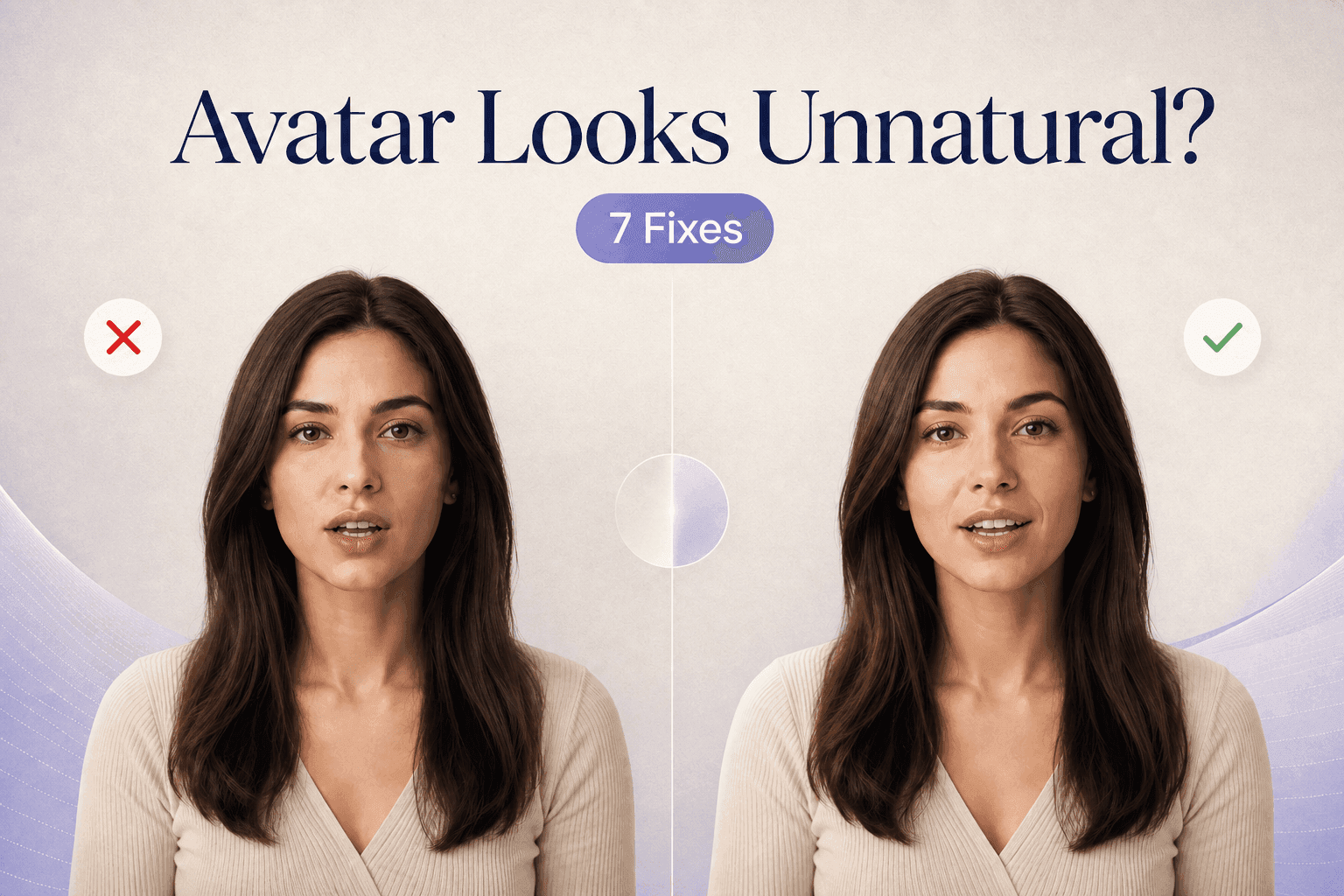
If your talking avatar looks unnatural, do not start by rerunning the whole clip. Find the layer that breaks first: the face source, the voice performance, the action prompt, or the edit context. Then change one input and test a short line.
Most weak avatar videos fail because one signal conflicts with the others. A calm portrait gets paired with an excited voice. A side-angle image tries to deliver a direct-to-camera script. A motion prompt asks for too many expressions. The fix is not "make it more realistic." The fix is to make every input ask for the same performance.
Start With the First Bad Frame
Before you change anything, watch the raw export in three passes.
- Play the clip normally with sound.
- Play it muted and watch only the face.
- Listen to the audio without looking at the avatar.
Write down the first moment that feels wrong. Do not judge the whole clip at once. The first bad frame often tells you which input caused the problem.
If the face changes while muted, start with the source image. If the face looks fine muted but feels fake with sound, start with voice and pacing. If the avatar moves too much, start with the action prompt. If the avatar looks fine in short sections but strange in the final edit, fix the edit context.
For a broader tool map before you build the next version, the DomoAI Guide can help you choose which creation tool belongs to each part of the workflow.
Map the Problem to One Input
Use this table before you regenerate.
| # | What Feels Wrong | Likely Layer | Fix First |
|---|---|---|---|
| 1 | Face shape changes, identity drifts, or the mouth looks unclear | Source face | Use a clearer portrait, safer crop, and more readable mouth area |
| 2 | Voice feels detached from the character | Voice performance | Change voice, pacing, emotion, or script length |
| 3 | Head and expression feel too busy or too stiff | Action prompt | Remove extra gestures and keep one visible action |
| 4 | Clip feels fake only in the final video | Edit context | Add cutaways, captions, or shorter presenter shots |
Do not fix all four at once. A new portrait, new voice, new prompt, and new crop may improve the clip, but you will not know which change mattered.
Use this rule when two layers look suspicious: fix the layer closest to the first visible failure.
If the face looks wrong before the first word, fix the image. If the first expression works but the speaking feels odd, fix the voice. If the voice sounds right by itself but the face overacts, fix the action prompt. If the raw export looks fine but the final social edit feels fake, fix the edit.
This order keeps the test cheap. You spend the least time on the change most likely to explain what the viewer sees first.
1. Source Problem: The Face or Mouth Is Hard to Read
The source image gives the model the face angle, mouth shape, gaze, lighting, and identity. A weak image creates weak evidence for every frame after it.
Fix first: replace or repair the source portrait before you change the script, voice, or action prompt.
Start with a portrait that has one visible face, a clear lower face, and even light. The mouth should rest naturally. The eyes should point in a direction that fits the scene. Leave enough space around the head and shoulders for small motion.
Avoid heavy shadow across the mouth, strong side angles, tiny faces, hands near the lips, microphones covering the jaw, and hair crossing the face. These details may look stylish in a still image, but they can make the moving result feel unstable.
A larger file does not solve a hidden mouth. Upscaling can sharpen edges, but it cannot reveal lip detail that never appeared in the source. If the mouth sits in shadow or behind a prop, choose another image.
If the portrait is close but not ready, use the Multi-Model Image Generator & Editor to fix one visual problem. Clean the background, widen the crop, or remove an obstruction. Do not redesign the whole character during a diagnostic test.
For anime and illustrated avatars, readability matters more than photorealism. Keep the mouth line clear, the eyes stable, and the face proportions consistent. A stylized character can still feel natural when the performance matches the design.
When you create a new source image, make two versions before you animate: a clean neutral portrait and a slightly expressive portrait. Test the neutral one first. If the neutral result feels too flat, test the expressive version with the same audio and prompt.
This gives you a controlled comparison. It also stops you from blaming the model when the source image already contains a conflicting expression.
2. Voice Problem: The Audio Does Not Match the Character
A natural-looking portrait can still feel fake when the voice does not fit. The viewer reads the face and voice as one performance.
Fix first: make the line sound like something the character could actually say in that scene.
Listen to the audio by itself and ask five questions:
- Does the pace sound like real speech?
- Do pauses land where a person would breathe?
- Does the emotion match the portrait?
- Are names, numbers, and abbreviations easy to hear?
- Does the voice fit the role of the avatar?
Write for speech, not for a report. Shorten long sentences. Remove stacked clauses. Put one idea in each breath. If a line looks elegant on the page but sounds stiff aloud, rewrite it.
If you need generated narration, create it with DomoAI Text to Speech. Use one clear mood. Emotion tags can help, but mixed directions can make the performance feel inconsistent.
If you upload audio, use clear speech or vocal audio. Remove noise, echo, clipped peaks, and accidental silence. If the clip needs music, add the music after export in CapCut, Premiere Pro, DaVinci Resolve, or another editor. Generate the avatar from the voice, not from a full mixed track.
3. Action Prompt Problem: The Avatar Overacts or Freezes
The action prompt should describe what the viewer can see. It should not ask the avatar to perform five different emotions at once.
Fix first: ask for one visible action with one timing cue.
Weak prompt:
Be expressive, excited, professional, natural, friendly, confident, and engaging.
Better prompt:
Calm presenter, direct eye contact, relaxed face, one small nod after the first sentence, soft smile at the end.
The second prompt works better because it gives the avatar a visible plan. It names the mood, the gesture, and the moment.
Use one of these based on the problem:
| Visible Problem | Prompt to Test |
|---|---|
| Too much nodding | Direct eye contact, relaxed face, minimal head movement, one small nod after the final sentence. |
| Smile feels wrong | Neutral presenter, soft expression, no wide smile, small blink during the pause. |
| Character feels frozen | Friendly host, subtle blink, slight head tilt on the question, small nod at the end. |
| Emotion changes too much | Steady calm expression, no surprise reaction, no large gestures, soft smile only after the answer. |
Keep the portrait and audio the same while you test these prompts. Change only the prompt intensity.
4. Edit Context Problem: The Raw Clip Works but the Final Video Feels Fake
A talking avatar does not need to carry every second. Use the avatar where a face helps, then cut to proof.
Fix first: shorten the visible avatar section or support it with another visual layer.
Good cutaways include:
- Product footage
- Screen recordings
- Captions and keywords
- Diagrams
- Before-and-after images
- B-roll
- Quote cards
Use the avatar for the hook, setup, transition, and final action. Use other visuals for detailed proof. This keeps the face from sitting on screen so long that tiny artifacts become distracting.
Editing also lets you hide one weak sentence, replace a short section, or add music after export. Treat the avatar as one layer in the video, not the whole video.
Run a Twelve-Second Repair Test
A full video hides the cause. A short test reveals it.
Build a 12-second test with one difficult phrase, one natural pause, and one clear ending. Use the same portrait each time.
Script:
Today we are testing a calmer avatar delivery. Pause here for one beat. Now watch the final expression.
Action prompt:
Friendly presenter, direct eye contact, relaxed face, one small head tilt on the first sentence, remain still during the pause, soft smile at the end.
Run the test in Talking Avatar. Name each version by the single changed input:
portraitA_voice-original_prompt-low_v01
portraitA_voice-slower_prompt-low_v02
portraitA_voice-slower_prompt-stillpause_v03
Review only four moments:
- First expression
- First difficult word
- Quiet pause
- Final expression
If version two improves the face and timing, the voice pace likely helped. If version three improves only the pause, the action prompt helped. This is the point of the test. It turns a vague reaction into a clear next move.
Save the winning inputs before you extend the script. Keep the source portrait, voice, and action prompt together in one project note. If you later change all three, you lose the baseline that made the short test work.
Score the Result Before You Keep It
Use this scorecard after each short test. Mark each line Pass, Review, or Fail.
| Check | Pass Condition | If It Fails |
|---|---|---|
| Identity | The face stays recognizable | Use a clearer image or safer crop |
| Mouth | Lips and jaw stay readable | Use a neutral mouth and better lighting |
| Voice | Pace and mood fit the face | Rewrite the line or change voice settings |
| Pause | The face settles when speech stops | Check audio silence and prompt intensity |
| Motion | Gestures support the sentence | Remove extra actions |
| Edit | The avatar appears only where useful | Add cutaways or shorten the shot |
Fix the first Fail. Do not chase every Review item until the main failure is gone.
If everything earns Review and nothing earns Fail, the clip may already be usable. Many creators over-polish avatar shots because they watch the same face ten times in a row. A first-time viewer will usually notice the message, the cut, and the supporting visual before one tiny expression.
Use the scorecard to decide what must change, not to hunt for flaws forever.
Frequently Asked Questions
Can Upscaling Fix an Unnatural Talking Avatar?
Upscaling can polish a good final take, but it cannot fix a hidden mouth, wrong voice, or busy prompt. Fix the inputs first. Then use the Video Upscaler on the selected clip.
Should I Change the Prompt or the Source Photo First?
Change the source photo first if the face looks wrong while muted. Change the prompt first if the face is clear but the movement feels too busy, too stiff, or timed to the wrong moment.
Can an Anime Character Look Natural?
Yes. Natural does not have to mean photorealistic. The character needs readable facial shapes, matching voice energy, and restrained movement that fits the style.
Why Does My Avatar Look Robotic Even When the Mouth Is Synced?
The voice may sound flat, the gaze may not fit the scene, or the action prompt may be too empty. Add one intentional expression cue rather than asking for general emotion.
Should I Keep Regenerating Until One Version Works?
No. Random retries hide the cause. Change one input, run a short test, and keep the version name clear.
Make One Controlled Fix
Find the first unnatural layer, then rerun a short test with one changed input. A better source, cleaner voice, calmer action prompt, or shorter edit can do more than another full blind regeneration.