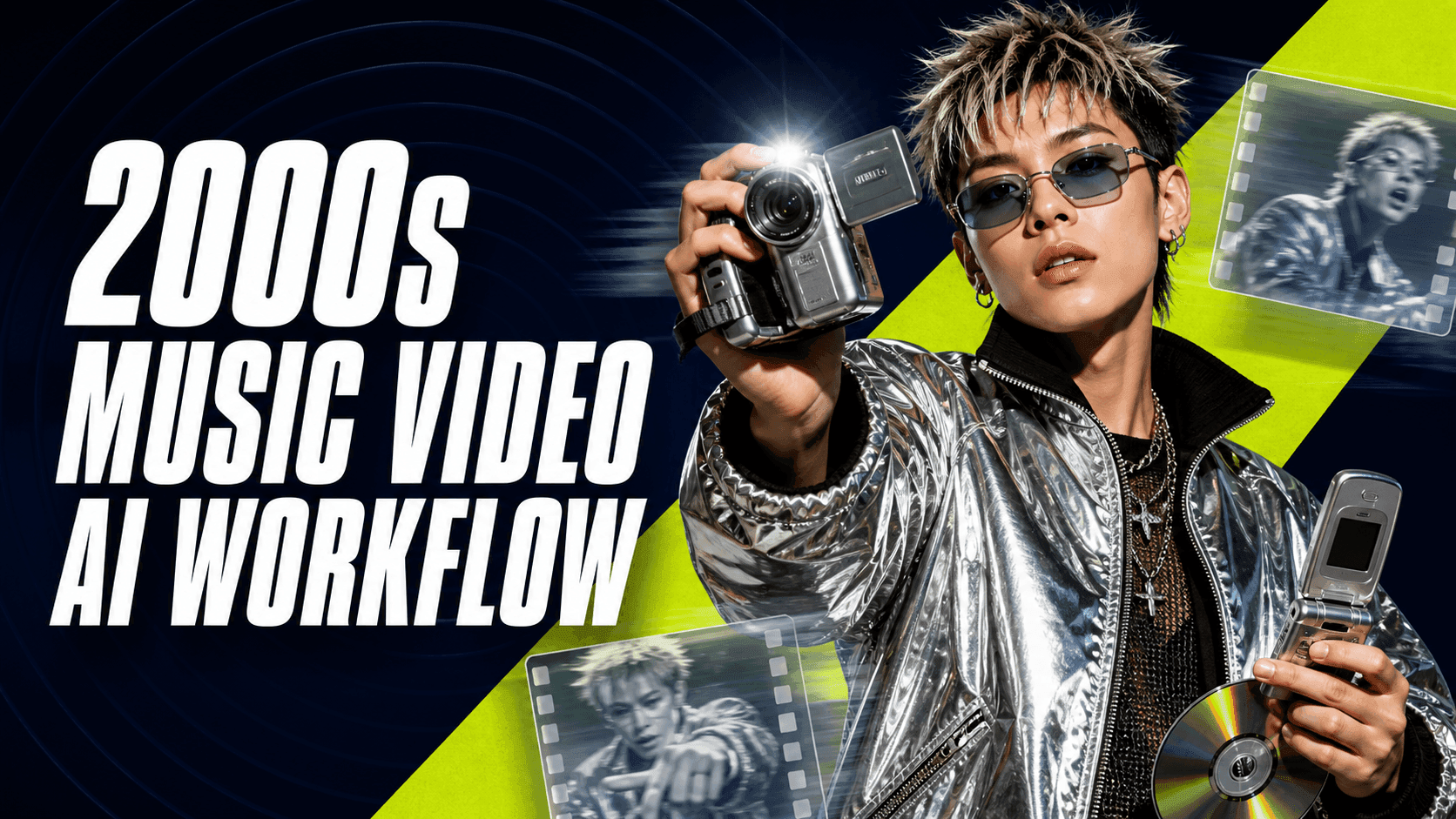
Pick the year you actually mean, prompt the way a camera of that year behaved, and generate short segments you cut to the beat afterwards. The look does not come from a filter, and the rhythm does not come from the model. Both come from decisions you make before you generate anything.
This is the reference page for the 2000s look. The scene-specific guides link back to the year bands and the style blocks below rather than repeating them.
First, Decide Which 2000s You Mean
"Y2K" in 2026 is not one aesthetic. It is at least three, and the pages that collapse them into one pink-and-chrome look are the reason prompts written from those pages produce a generic vintage filter.
The Cultural Archive of Rare and Interesting (CARI) places McBling at roughly 2000 to 2008 and treats it as a turn away from millennial futurism, not a continuation of it. Fashion coverage, meanwhile, has widened "Y2K" into general early-2000s shorthand — Who What Wear was still using it that way in 2026. And the people who care most argue about it constantly. A 371-point r/decadeology thread is titled, in part, "'y2k' is to 2000s as '2016' is to 2010s … they end up showing the wrong aesthetic/style". Inside it: "Y2k is not supposed to be mid 2000s. Y2k is 1999-2001." And: "more like '99-'03. But not '00-'09 and especially not '04-'09."
Treat the boundaries as contested, because they are. What follows is a working selector, not a settled taxonomy.
| Band | What to call it | Concrete markers | How the camera behaved |
|---|---|---|---|
| 1999–2003 | Y2K futurism | chrome, translucent and frosted plastic, silver, low-poly digital graphics, CRT glow, candy-bar phones | broadcast-clean, hard key light, studio-controlled |
| 2003–2008 | McBling / digicam | maximalism, logo-heavy tracksuits, rhinestones, low-rise denim, flip phones, mall interiors | direct undiffused flash, low dynamic range, clipped highlights, warm shifts, candid framing |
| Late 2000s | Indie sleaze | party venues, DIY, smudged eyeliner, leather, striped shirts, early-web tech | intrusive on-camera flash, handheld drift, high-ISO noise, snapshot framing |
The cleanest working distinction found anywhere in the research came from that same thread: "Y2K futurism = late 90s/early 2000s optimistic feeling for technological progress … Mcbling = focus on glamor and hyperfemininity in the 2000s." One is about the future. The other is about money.
Why this matters more than any prompt trick, in one commenter's words: people "don't get it right even in a stereotypical sense … because they don't understand the design nor care to learn about what makes it what it is."
Name your band in your first prompt. Everything downstream depends on it.
What Makes It Read As 2000s, And What Reads As A Filter
There is a natural experiment sitting in the top r/Y2K post of the year: someone bought a 2006 point-and-shoot with the previous owner's photos still on the card. It has 13,067 points, and the top comment, at 536, is not about grain or grade:
"fun party scenes, candid shots, goofy poses, lived-in rooms. Now you see a lot more very posed and curated photos … the background is a perfectly clean room looking like a museum with no clutter or signs of life anywhere in sight."
Clutter and candour read as 2000s. Clean and posed read as now. That thread's roll-call of incidental props — Red Bull, Chap Stick, gum — dates the pictures faster than any colour grade could.
The same principle holds at professional scale. A 323-point r/decadeology crowd audit of a recent period music video praised restraint over density: "Often people go too crazy with these throwback sets … but this looked like a real house. … they even filmed the whole thing with film instead of a digital camera."
On the technical side, the digicam look is a set of interacting cues rather than one effect. Adorama's account of the CCD revival lists soft focus, close undiffused flash, grain, warm shifts, clipped highlights and shadows, blooming speculars and candid composition — and cautions that "CCD" on its own is not the look. No source found in this research establishes interlacing, JPEG blocking or date stamps as required rather than optional. Treat them as available, not mandatory.
One more thing before you set your output resolution. On a 2000-set period clip a viewer noted "the old camcorders not so sharp. A bit more grainy", and when the creator offered a 4K version the reply was "I don't think going 4k will be an improvement. If you're striving for realism, perhaps going lower res would be better." An image-side guide on r/StableDiffusion says the same.
DomoAI Omni Reference offers 480P and 720P. On a period project, 480P is a legitimate creative choice rather than a compromise — weigh it against your delivery platform.
The Shared Look Recipe
Here is the rule the rest of this cluster inherits, and the one thing most easily got wrong:
Prompt the capture behaviour. Do not prompt the damage. Capture behaviour is what the camera and film stock did: exposure, flash falloff, low dynamic range, handheld drift, motion blur, restrained grain, chroma bleed. That belongs in the prompt. Damage is what happened to the tape afterwards: glitch, dropout, scanline tearing, tracking error. That belongs in a post layer, if it belongs anywhere.
The reason is mechanical. A generated artifact is attached to the subject and deforms with it, while a post layer is attached to the frame and stays put. Vidwave's retro-look guide reports generated grain and dust warping into subject geometry under motion, and creators on r/AI_Forge recommend applying date stamps, camera UI, compression and tape noise globally in the edit.
Be honest about the state of the evidence: this is a mechanism, not a proven result. Other creators on r/aivideos report improved realism from prompting specific, restrained defects such as "slight compression artifacts" and "mild interlacing grain". No controlled test settles it. The working compromise is bounded capture defects in the prompt, unbounded damage in post.
Base style block, 1999–2003 futurism
broadcast-clean early-2000s music video capture, hard key light with a defined shadow edge,
high-gloss and chrome surfaces, translucent frosted plastic, controlled studio falloff,
film stock rather than digital video, restrained grain, in-camera reflections,
saturated but not crushed colour, confident locked-off framing
Base style block, 2003–2008 McBling / digicam
mid-2000s consumer digicam capture, close undiffused on-camera flash, low dynamic range,
clipped highlights and blocked shadows, warm colour shift, blooming speculars, soft focus,
visible grain, candid handheld framing, lived-in cluttered interiors
Base style block, late-2000s indie sleaze
late-2000s party snapshot capture, intrusive direct flash with harsh falloff into darkness,
high-ISO noise, handheld drift, imperfect exposure, motion blur on moving subjects,
snapshot framing that misses as often as it lands, crowded venue interiors
Shared negative block
heavy VHS glitch, excessive scanlines, date stamp, HDR, teal and orange grading,
perfect gimbal stabilization, hyper-sharp 8K, glossy studio advertisement,
glossy commercial photography, pristine product render, brand logos,
copyrighted characters, readable trademark packaging, random text, watermark
Every entry above is lifted from the global negative lists in two of our own production style kits — the nostalgia kit and the analog road-trip kit — rather than written for this page. That is why the anti-damage rule is a working practice here and not a theory.
And a shorter list that matters more: the words to stop using. Our own capture-realism system keeps a ban list of image-prompt words that all pull toward the same glossy concept-art result, no matter what era you asked for:
premium, cinematic, surreal, dramatic, elegant, breathtaking, masterpiece,
hyper-realistic, ultra-detailed, 8K, perfect, pristine, glossy, epic,
physically coherent, highly polished, symmetrical hero composition
These are reward words. They do not describe anything a camera did, so the model falls back on its prior — and its prior is an advertisement. Replace each one with concrete capture evidence: what the light source was, where focus fell away, which surface held a fingerprint.
Two recipe-level rules the scene guides do not each rediscover:
Dress every visible person, extras included, or they come out modern. In a 152-take same-prompt comparison run in ComfyUI between LTX-2.5 and MiniMax H3 (r/comfyui, 2026-08-14), the tester's summary was blunt: "Declare a costume for EVERY character or they come out modern. An undescribed woman got a contemporary dress; my 399 BC agora crowd came out in cargo shorts with a wristwatch until the prompt said 'bare wrists and bare forearms'." Those are other models on another surface, so read it as what creators report rather than as Seedance 2.5 behaviour — but a period video is exactly where an undescribed extra costs you the shot.
Write your bans as positive descriptions. From the same test: "Negatives are inert at cfg 1/1 (same story as Flux). Rewrite every ban in positive form." The negative block above still earns its place, but it is a backstop. "Don't make it look modern" does nothing. "Bare wrists and bare forearms" does the work.
And a trick worth stealing from a retro production that ran eight months: instead of naming a year, name what the year could physically do. The creator of CYBER SLAYER, posting to r/StableDiffusion in August 2026, put it as "I tried to think about what could realistically have been done in 1995 … I often prompted for latex creatures, animatronics, puppets, miniatures or physical models." The 2000s equivalent is film stock, built sets, practical lighting and in-camera reflections — not the words "2000s style".
Build The Shots: Anchor, Variants, Video
The chain is fixed, and the first step is the one people skip.
- Midjourney generates the identity anchor. One clean, front-facing, full-body image of your performer, neutral background, no readable text or logos.
- GPT Image 2 generates every variant from that anchor — new wardrobe, new location, new light. Never generate the first identity image here.
- Seedance 2.5, ByteDance's model available in DomoAI Omni Reference, generates the video from those images.
- Suno, optionally, for an original track.
- Your editor adds every piece of text: titles, logos, lyrics, CTA.
There is a trap in step 2 that costs people the whole look. A reference image controls identity and finish. If your Midjourney anchor came out glossy, GPT Image 2 will faithfully reproduce the gloss into every variant, and no amount of era vocabulary downstream will remove it.
So say what the reference may and may not donate. This is the clause our capture-realism system uses, and it is worth pasting verbatim:
The supplied image controls only the subject's identity, geometry, wardrobe, and
color boundaries. Do not inherit its lighting, background, surface polish,
rendered finish, or centered composition.
In Omni Reference, references are addressed by upload order — Image 1 is the first image you uploaded, Image 2 the second. Give each one exactly one job. Image 1 is the literal first frame and also fixes location and light direction; any face-only reference after it needs the same kind of exclusion, or it will fight the first frame for the composition.
Use the minimum sufficient references. The surface accepts a lot of them, and every extra one adds ambiguity unless it has a named role. The full mechanism, including how many references a costume change actually needs, is covered in keeping one performer consistent across shots.
Cutting To The Beat: Why The Audio Reference Is Not The Editor
This is the part readers get wrong, and it is worth being precise about.
An audio reference in Omni Reference controls soundtrack or dialogue timing. It does not detect beats, it does not drive cut points, and it will not place an edit on a downbeat for you. Cut timing happens in your editor. Always.
So the workflow runs backwards from what you would expect: you decide your cut durations first, then generate segments to fit them.
Work out your bar length. In 4/4, one bar lasts 240 ÷ BPM seconds. At 120 BPM that is exactly 2 seconds a bar; at 96 BPM it is 2.5; at 140 BPM it is roughly 1.71.
Choose segment durations in whole bars. At 120 BPM, a three-bar segment is 6 seconds and a four-bar segment is 8. Those are the numbers you request, not "about six seconds".
Generate a little long, then trim to the transient. Omni Reference generates from 4 to 30 seconds. If you need 6 seconds of usable motion, ask for 7 and cut the head and tail on the waveform. A segment that ends exactly on your intended cut leaves you no handles.
Keep one action and one camera move per segment. This is not a stylistic preference. Creators working across several models report the same collapse when prompts get crowded — one r/AIAnimeVHS tester's verdict was that "the more you add to it, the more it changes towards some generic anime stuff". One thing per generation is how you keep the era-specific detail from being averaged away.
Worked Example: A 30-Second Chorus In Six Shots
A 120 BPM chorus, 2 seconds a bar, 2003–2008 McBling band, 9:16.
| Shot | Bars | Duration | Content | Camera |
|---|---|---|---|---|
| 1 | 2 | 4s | performer enters frame, direct flash catches the tracksuit | locked off, chest height |
| 2 | 3 | 6s | hook line, performer walks toward lens | slow push in |
| 3 | 2 | 4s | cutaway — flip phone on a cluttered dresser | static macro |
| 4 | 3 | 6s | second performer joins, both in frame | handheld drift right |
| 5 | 2 | 4s | mall-interior wide, extras in period wardrobe | slow pan left |
| 6 | 3 | 6s | performer close-up, holds eye contact to the cut | slow push in |
Six generations, each requested a second long, trimmed on the waveform. Shot 5 is where the "dress every extra" rule earns its keep: leave them undescribed and they arrive in 2026 clothing.
Grade Once, At The End
Every piece of text in the finished video goes on in post: song title, artist name, lyric overlays, your logo, the CTA. Do not ask the model to render readable text. Garbled on-screen writing is the tell fact-checkers rely on to identify synthetic video — Annielab documented exactly that case in 2025 — and it will do the same to your period piece.
Two rules from our own generation protocol belong here, because both are about resisting the urge to fix a look after the fact. Never ask the image model to make a result "more cinematic" — generic enhancement amplifies the synthetic finish. Regenerate from the anchor with a full capture profile instead. And add grain, halation, gate weave and compression in the finishing pass, not by asking the still model to exaggerate them.
Grain, tape noise, compression, date stamps and any camera UI go on as a single global layer over the finished cut, not per clip. A creator chasing "the video aesthetic of the early 2000s, keeping the grain, the image imperfections" found the generation pipeline stripping it back out, and posting to r/StableDiffusion in August 2026 reported fixing it with a post stage. Reported UGC practice lands around 15% grain intensity — "enough to see texture but not so much it looks like vhs."
Fix The Band, Not The Grade
Three failure modes, three causes.
It looks generic. You never chose a year band. Go back to the selector and pick one, then rewrite the style block. No amount of grading fixes an unchosen era.
It looks damaged rather than old. Damage went into the prompt. Strip glitch, scanline and tracking language out of the generation and move it to a post layer.
It looks too clean. You specified the era's props but not its capture behaviour. Our keeper test rejects a frame when two or more of these are true: every edge is equally sharp; the subject is centred with no story reason; all materials share one gloss level; the lighting cannot be traced to a real window, lamp, sign or fixture; the background holds no ordinary object, wear or capture accident. Add the flash falloff, the clipped highlights, the handheld drift.
A fourth, if extras keep arriving from the present: you described your lead and nothing else. Describe everyone in frame, and describe absences positively.
Where This Fits: The Rest Of The 2000s Cluster
This page owns the year bands, the style blocks and the beat-cutting workflow. The scene guides build on them:
- Y2K Pop Star Video — one identity across several wardrobe and set changes, in the 1999–2003 band.
- Indie Sleaze Music Video — the flash-and-noise texture of the late-2000s band, in depth.
- 2000s Street Racing Video — holding vehicle geometry steady across shots.
- 2000s Teen Drama Scene — multi-beat dialogue scenes with assigned speakers.
For a broader tool survey rather than a period workflow, see the anime music video tool roundup, or the AI Music Video Generator scenario hub.
How This Compares To One-Prompt "Y2K Filter" Tools
Template generators that rank for "Y2K AI video" hand you a preset and a slider. What they leave out is everything this page is about: which year band you are in, how a camera of that period behaved, and what happens when you overdo the effect. A preset applies damage uniformly to whatever you feed it — the exact failure mode described above, sold as a feature.
A preset is faster. A chosen band, a capture-behaviour style block and beat-planned durations are slower, and they are the difference between footage that reads as 2003 and footage that reads as a filter.
Frequently Asked Questions
What actually makes a video look like the 2000s?
Capture behaviour and set dressing, not effects. Direct undiffused flash, low dynamic range, clipped highlights and candid framing carry the era. Cluttered, lived-in rooms carry it further. Heavy tape damage reads as a filter rather than a date.
Is Y2K the same as the 2000s aesthetic?
No, and the boundaries are actively disputed. Y2K futurism is roughly 1999 to 2003 and is about optimism toward technology. McBling runs to about 2008 and is about glamour and excess. Name a year range whenever you use either term.
Can AI match video cuts to a song's beat?
Not through an audio reference. In DomoAI Omni Reference an audio reference controls soundtrack or dialogue timing, not cut points. Plan segment durations in whole bars, generate slightly long, and place the cuts in your editor.
Should I add VHS effects in the prompt or in editing?
Bounded capture defects such as restrained grain or soft focus can go in the prompt. Unbounded damage such as glitch, dropout and tracking error belongs in a post layer, because a generated artifact deforms with the subject while a post layer stays attached to the frame.
What aspect ratio and resolution should a 2000s-style AI music video use?
Omni Reference offers Auto, 3:4, 4:3, 9:16, 16:9 and 1:1, at 480P or 720P. Use 4:3 for camcorder-era material and 9:16 for short-form delivery. Many creators find lower resolution more convincing for period footage, so weigh 480P against where the video will be posted.
Can I use a real 2000s song?
Music rights are yours to clear and are outside what this workflow covers. For an original track, generate one. Do not generate visuals designed to resemble a specific real artist, video or brand.
Choose The Year Before You Choose The Grade
Almost everything that makes AI period footage fail is decided before the first generation. The band is unchosen, so the look averages out. The extras are undescribed, so they arrive from the present. The damage goes in the prompt, so it warps with the subject. The cuts are left to the model, so nothing lands on a downbeat.
Pick the year. Describe everyone in frame. Prompt what the camera did, not what happened to the tape. Then cut it yourself.