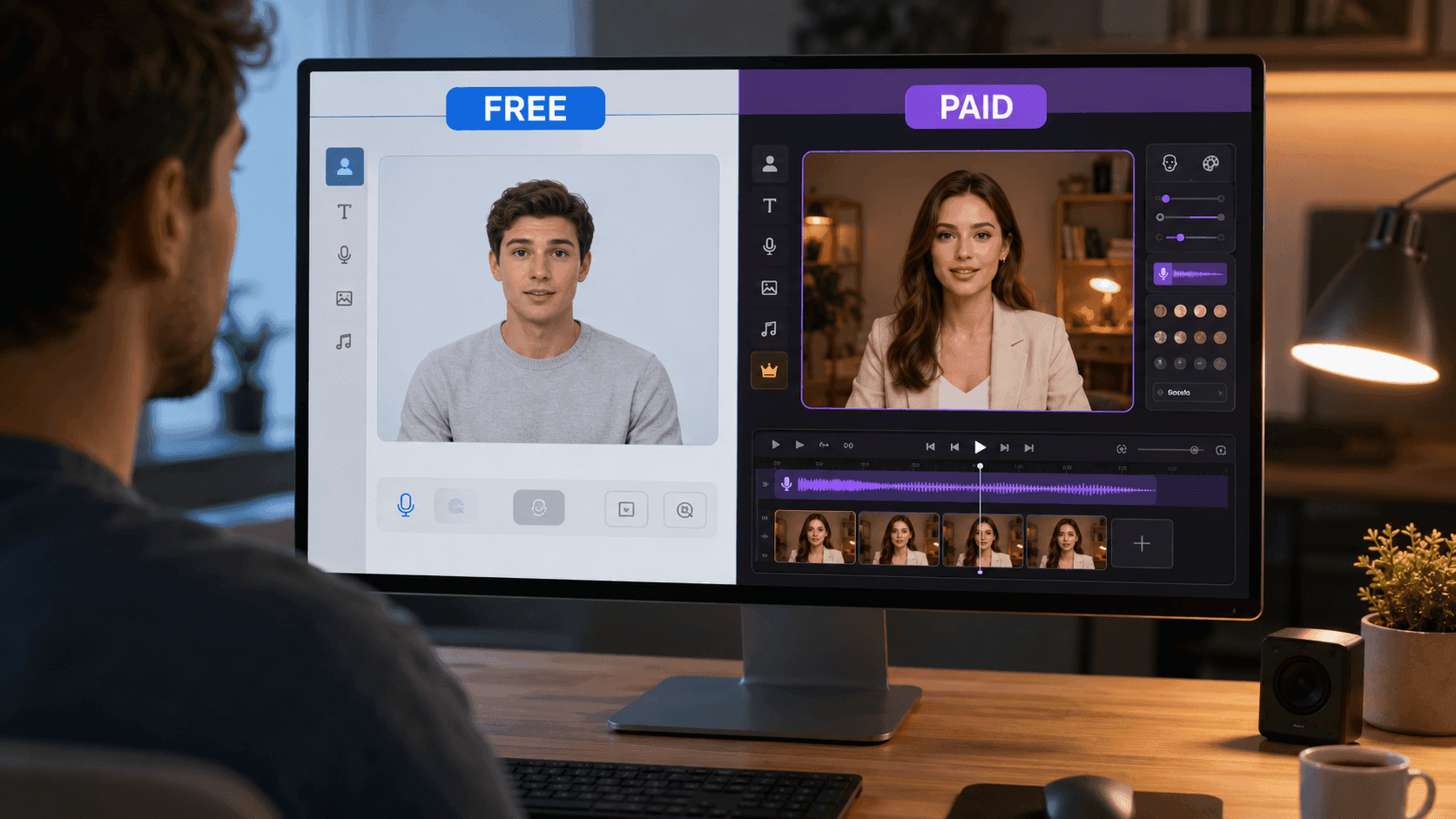
Use the free tier to prove that your portrait, voice, and workflow work. Pay only when a watermark, duration cap, credit limit, queue, or usage rule blocks the file you need. A longer feature list is not a reason to upgrade.
What “Free” Actually Means
The word “free” can describe several access models. Compare them separately because each one supports a different level of testing, exporting, and ongoing production use.
| Free Access Type | What It Usually Allows | Main Limitation to Check |
|---|---|---|
| No-export demo | Preview a feature or sample result | You may not receive a usable file |
| One-time trial | Spend an initial allowance | Credits may not renew |
| Recurring free tier | Generate a small monthly amount | Watermark, duration, speed, or feature limits may apply |
| Local or open-source software | Run the workflow on your hardware | Setup, hardware, maintenance, and processing time become your cost |
A free trial can be enough to answer an important question: “Can this tool animate my face, character, or voice acceptably?” It is not proof that the same access will support weekly production.
Record the access type before comparing tools. Check the account and card requirements, credit reset, download access, and what remains after the trial ends.
This distinction makes each access type easier to use well. A one-time allowance is ideal for focused evaluation, while recurring production benefits from a monthly plan. DomoAI's credit and plan rules clearly organize trial access, monthly credits, eligible Relax Mode tasks, and plan-specific features.
Compare the Limits That Affect Delivery
Paid plans usually remove constraints; they do not automatically rescue a weak portrait or recording. Start with the requirements your final video must meet.
Check these fields in the current plan documentation and account interface:
- Generation allowance: Credits, seconds, minutes, or videos included in the period
- Maximum duration: The longest supported clip for the selected feature and tier
- Watermark: Whether free exports carry a visible mark and whether it blocks the planned use
- Resolution: The actual export resolution, not only the project canvas size
- Speech input: Text to Speech, uploaded audio, direct recording, or voice cloning
- Language and voice access: Which options are available at the tier you would buy
- Queue priority: Whether free or lower tiers wait longer during busy periods
- Parallel tasks: How many generations can run at once
- Commercial terms: Whether the plan permits the intended business or client use
- Privacy and retention: How uploaded faces, voices, and generated files are handled
- Support: The help available when a deadline or account issue blocks production
Separate must-haves from conveniences. A watermark may work for an internal test but fail a client ad. A large avatar library adds little to a one-mascot project.
Use a requirement table before reading plan pages:
| Requirement | Minimum Acceptable | Deal Breaker? |
|---|---|---|
| Monthly finished videos | 12 | Yes |
| Clip duration | 45 seconds | Yes |
| Watermark | None | Yes |
| Export | 1080p | Preferred |
| Uploaded voice | Required | Yes |
| Queue time | Same business day | Preferred |
This table turns a broad pricing comparison into a fit check. A cheaper plan that misses one required input or export condition can cost more than a higher plan that produces the needed file.
When higher resolution is the priority, include Video Upscaler in the plan comparison and choose the most efficient finishing path.
Calculate the Cost of a Usable Minute
Credits alone do not reveal total production cost. Include failed attempts, revisions, cleanup, and final editing time when you estimate what one usable minute requires.
Use this worksheet:
- Estimate the total finished minutes needed each month.
- Estimate how many generated versions each finished minute requires.
- Add failed or discarded renders from your free test.
- Include separate voice, caption, or editing costs.
- Add the time spent waiting, reviewing, and correcting.
- Divide the total monthly cost by the finished minutes you can publish.
The basic calculation is:
Cost per usable minute =
(plan cost + extra credits + other tools + production time cost)
÷ finished published minutes
Consider a hypothetical case. A creator needs 10 finished minutes and expects two generations for every usable minute. The plan must cover about 20 generated minutes before failed attempts or last-minute revisions. A plan advertised around finished output alone may not provide enough capacity.
Also check how the provider handles unsuccessful generations. Treat retry cost as unknown until the current policy or your own test confirms it.
Time can change the answer. A long free queue may suit a hobby project but miss a client deadline. Local software removes the subscription, not the setup, rendering, or hardware cost.
Test the Free Version Before You Upgrade
A controlled free test in Talking Avatar, using supported image and audio inputs, shows which plan features add practical value to your production workflow. Keep the task identical across candidates.
Prepare:
- One clear, front-facing portrait
- One illustrated or non-human character if that matters to your work
- One 10-second script
- One clean recording of the same message
- One target aspect ratio and export requirement
Then record:
- Account and card requirements
- Time from upload to first generation
- Credits or allowance consumed
- Lip timing and mouth behavior
- Identity and motion stability
- Retry count
- Watermark and export resolution
- Whether the downloaded file meets the intended use
Do not upgrade immediately after one impressive preview. Run at least one correction, such as changing a name, replacing the audio, or reducing a distracting gesture. Production tools must support revision, not only first attempts.
Save screenshots of the free limit and the finished export. Plan pages change, and the evidence helps you compare the offer you actually tested with the plan you are considering.
Before checkout, compare the tested requirement with current DomoAI pricing, especially duration, credits, watermark, Relax Mode, and feature access.
For the strongest starting point, refine the source portrait or choose a clearer crop before selecting the production plan.
Use a Threshold, Not a Feature Wishlist
Upgrade when a specific, verified limit prevents delivery. Staying free is sensible when the current access still produces every required file you need on schedule.
Stay free when:
- You are learning the workflow or validating one concept.
- The allowance covers your actual output volume.
- A watermark is acceptable for private or internal testing.
- Slow generation does not affect a deadline.
- You do not need paid-only duration, resolution, voice, or rights.
Consider a paid plan when:
- The free allowance runs out during normal monthly work.
- A watermark makes the file unusable.
- Required clip lengths are unavailable.
- Slow queues or limited parallel tasks delay production.
- You need specific voices, languages, inputs, or export quality.
- Client, team, privacy, or support requirements exceed the free offer.
Score each requirement from zero to three:
0: Not relevant1: Convenient2: Important3: Required for delivery
Payment is justified only when it resolves one or more requirements scored three and the free option cannot. This method avoids paying for attractive features that do not improve the final workflow.
Three Scenarios With Different Answers
Volume, deadlines, and usage rights change the answer. These three examples show where the upgrade line moves.
| Scenario | Likely Starting Choice | Upgrade Trigger |
|---|---|---|
| One experimental social clip | Free trial or recurring free tier | The result cannot be downloaded or tested properly |
| Weekly branded short | Paid may make sense | Watermark, monthly capacity, or required resolution blocks publishing |
| Multilingual training batch | Paid or business plan is more likely | Duration, language workflow, review volume, support, or privacy requirements exceed free access |
One-off creators should spend only after the concept works. Weekly publishers need to compare cost per usable minute and revision speed, whereas training teams must add governance, review, privacy, and support to the decision.
These are decision patterns, not universal plan recommendations. Always verify the current offer in the target region and account before publishing a price or feature claim.
Frequently Asked Questions
Is a Free Trial the Same as a Free Plan?
No. A trial usually provides one-time access or credits, while a free plan renews under stated conditions. Check reset dates, expiry, export, and card requirements.
Are Paid Talking Avatars Always Better Quality?
No. Payment may change model access, resolution, duration, speed, or limits, but input quality still matters. Compare the same portrait and speech before assuming a paid tier fixes visual problems.
Can I Use a Free Talking Avatar Commercially?
It depends on the provider’s current terms. Verify the rights attached to your image, voice, music, and other assets, plus the exact plan and intended use, before publishing.
Which Paid Plan Should I Choose?
Choose the lowest current tier that meets every required input, duration, export, volume, and usage condition. Ignore features that do not change your deliverable.
Pay for the Blocker, Not the Feature List
Define the deliverable and run one controlled test. If the free path produces the right file on schedule, keep it. If one verified limit blocks publication, pay for the lowest tier that removes that limit.