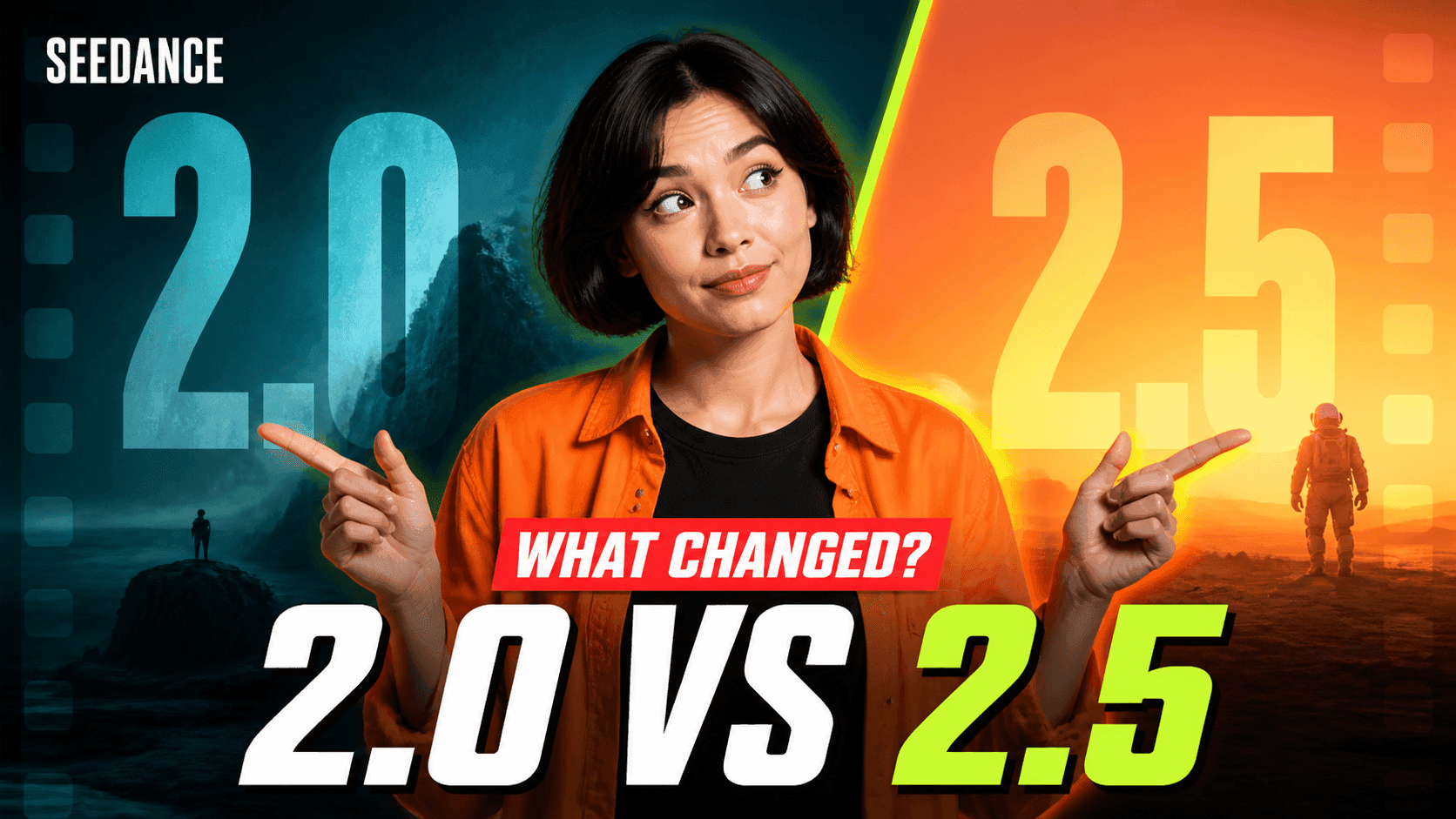
Seedance 2.5 ist kein direktes Upgrade gegenüber 2.0. Zwei unabhängige Creator ließen die gleichen Prompts durch beide Modelle laufen und 2.0 gewann mehrere Kategorien auf Anhieb. Ich habe seit der Veröffentlichung am 31. Juli jeden Test gelesen, den ich finden konnte, und das Bild ist komplizierter, als die meisten Vergleichsseiten vermuten lassen.
Ich habe bereits darüber geschrieben Seedance 2.5-Beispiele – kreative Ideen basierend auf dem, was frühe Showcases versprachen. Dieser Beitrag ist anders. Es ist die Analyse der Belege: Was hat sich tatsächlich verbessert, was hat sich verschlechtert, was kostet mehr und welche Version passt heute zu welcher Aufgabe.
Stand vom 10. August 2026: ByteDance startete Seedance 2.5 am 31. Juli in seinen eigenen Apps – Dreamina, Jimeng AI und Doubao Pro – für zahlende Abonnenten in Südostasien, dem Nahen Osten, Afrika, Europa und Südamerika, mit Ausnahme der USA. Seitdem wird es in Tools von Drittanbietern angezeigt, sodass die meisten Menschen außerhalb dieser Regionen darauf zugreifen können. Für Seedance 2.0 ist keine Abkündigung angekündigt.
Eine Namensfalle vorab: „DomoAI 2.5“ und „Seedance 2.5“ sind zwei unterschiedliche Modelle. Seedance ist ByteDance, integriert durch andere Tools über einen API. DomoAI 2.5 ist unser eigenes Modell, es läuft ein Bild zu Video Nur, und es wird Ihnen nicht die 30-sekündige One-Take-Generation geben, um die es in diesem Beitrag geht. Die beiden teilen sich eine Versionsnummer und sonst nichts. Dies ist unser Blog, daher liegt es an uns, die Kollision aufzuklären – alles unten bezieht sich auf Seedance, sofern nicht anders angegeben.
Wo sich Seedance 2.5 derzeit tatsächlich befindet
Das ist die Tatsache, dass die meisten Vergleichsseiten falsch liegen, und wenn man etwas falsch macht, verschwendet es die Zeit der Leser.
Seedance 2.5 war offiziell am 31. Juli bekannt gegeben . Bezahlte Abonnenten der eigenen Apps von ByteDance – Dreamina, Jimeng AI, Doubao Pro – können es auswählen unterstützte Regionen : Südostasien, Naher Osten, Afrika, Europa und Südamerika. Die USA sind von diesem Rollout ausgeschlossen und sind es immer noch.
Diese regionale Kluft ist der Grund dafür, dass die Verfügbarkeitsfrage so verwirrend ist und warum „Kann ich es verwenden?“ und „Ist es eingeführt?“ je nach Standort unterschiedliche Antworten haben.
Der zweite Weg sind Tools von Drittanbietern, die das Modell integriert haben. Mehrere haben mit der Auslieferung begonnen, auch unseres – Seedance 2.5 läuft in DomoAI Omni Reference ab 10. August, ohne regionalen Ausschluss. Ich behaupte nicht, dass es sich dabei um eine neutrale Beobachtung handelt. Behandeln Sie es also als Offenlegung und nicht als Empfehlung: Prüfen Sie, für welches Tool Sie bereits bezahlen, bevor Sie sich für ein anderes anmelden.
Das Nützlichere, was man von der Drittanbieter-Route mitnehmen kann, ist struktureller Natur. Was eine Produktoberfläche freilegt, ist immer schmaler als das, was das Modell leisten kann , und jede Integration zieht diese Grenze an einer anderen Stelle. ByteDance dokumentiert die Bearbeitung auf Regionsebene, Maya/Blender-Plugins und die 3D-Weißmodellsteuerung; Ich habe keine Oberfläche eines Drittanbieters gesehen, die eines davon offenlegt. Auflösungsobergrenzen und Dauerbereiche variieren ebenfalls je nach Integration. Wenn Sie also eine Spezifikation auf einer Vergleichsseite lesen, stellt sich zunächst die Frage, um welche Spezifikation es sich handelt – um die Implementierung des Modells oder eines Produkts. Die meisten falschen Zahlen in dieser SERP sind darauf zurückzuführen, dass sie als dasselbe behandelt werden.
Der API von Seedance 2.0 bleibt aktiv. Es istDas Tutorial wurde am 3. August aktualisiert , und es gibt kein offizielles Ablaufdatum.
Seedance 2.5 vs. 2.0 auf einen Blick
In dieser Tabelle handelt es sich um die Modelle, nicht um deren Implementierung durch ein einzelnes Produkt. Wenn es sich bei einer Spezifikation um eine Herstelleraussage handelt, die niemand unabhängig reproduziert hat, steht dies darin.
| Kategorie | Seedance 2.5 | Seedance 2.0 |
|---|---|---|
| Angekündigt | 31. Juli 2026 | 12. Februar 2026 |
| Native Dauer | Bis zu 30 Jahre in einer Generation | 4–15s |
| Referenzeingänge | Bis zu 30 Bilder + 10 Video + 10 Audio | Bis zu 9 Bilder + 3 Video + 3 Audio |
| Natives Audio | Ja, gemeinsame Audio-Video-Generierung | Ja – Stimme, SFX, BGM |
| Bearbeiten | Zeitstempelebene, Region, Greenscreen, Kamera, White-Model-Steuerung – alles von ByteDance dokumentiert, nichts unabhängig verifiziert | Gezielte Überarbeitung, Erweiterung, Fortführung |
| ByteDances eigene Apps | Dreamina / Jimeng / Doubao Pro, USA ausgenommen | Weit verbreitet |
| Kosten vs. 2.0 | Ungefähr 2x (mehrere Quellen stimmen über das Verhältnis überein) | Veröffentlichte Token- und Videopreise |
| Abwertung | N/A | Keine angekündigt |
Nun der Teil, den die Tabelle nicht anzeigen kann, und der Grund, die Spezifikationen misstrauisch zu lesen. Eine Produktoberfläche stellt eine Teilmenge dessen bereit, was das Modell tun kann, und jede Integration wählt eine andere Teilmenge aus. Einige funktionierende Zahlen, von der einen Oberfläche aus kann ich direkt überprüfen: ByteDance 2.0 API dokumentiert 4K, 21:9 und adaptive Verhältnisse, aber unsere eigene Seedance 2.0-Implementierung stellt 480P–1080P und fünf Verhältnisse bereit. Auf 2.5 belichten wir 4–30 Sekunden bei 480P oder 720P und bearbeiten keines der ByteDance-Dokumente auf Regionsebene. Ich verwende uns als Beispiel, weil ich es überprüfen kann, nicht weil es repräsentativ ist – Dreamina, Jimeng und jede andere Integration haben woanders ihre eigenen Grenzen gezogen.
Nichts davon ist ein Mangel. Eine Produktoberfläche besteht aus einer Reihe von Auswahlmöglichkeiten. Dies bedeutet jedoch, dass eine zitierte Spezifikation ohne Quellenangabe nahezu nutzlos ist und die Leser sich an den Produkteinstellungen und nicht am Datenblatt des Modells orientieren.
Was sich in 2.5 wirklich verbessert hat
Ich möchte 2.5 gegenüber fair sein, bevor ich zu den Problemen komme. Einige Dinge sind eindeutig besser.
Die 30-Sekunden-Single-Pass-Generierung ist real und funktioniert. Dies ist das Schlagzeilenmerkmal und das mit den stärksten Beweisen. @techhalla hat ein gepostet Frozen-Time-Diner-Szene (191.000 Aufrufe) mit zeitcodierten Shot-Listen als Ansagen – sechs unterschiedliche Beats in einer Generation. PJ Accetturo, wer war Frühzeitiger Zugriff durch ByteDance gewährt (123.000 Aufrufe) veröffentlichte einen kompletten Drachen-Rampage-Prompt mit sechs Schüssen, der als einzelne 30-Sekunden-Generation läuft. Bei One-Take-Actionsequenzen ist das 30-Sekunden-Fenster wirklich differenziert.
Originalbeitrag auf X ansehenhttps://x.com/techhalla/status/2083389002552664385
techhallas eingefrorene Diner-Szene – die deutlichste öffentliche Demonstration einer einzelnen 30-sekündigen Seedance 2.5-Generation mit mehreren unterschiedlichen Beats. 191.000 Aufrufe.
Die Referenzeingänge stiegen von 15 auf 50. Das Modell akzeptiert bis zu 30 Bilder, 10 Videoclips und 10 Audioclips. @techhalla hat dies direkt mit getestet42 Bildreferenzen in einer Generation (27.000 Aufrufe) – ein veröffentlichtes Ergebnis mit sichtbarer Eingabeaufforderung, kein Anbieteranspruch. Die Integrationen, die mit 2.5 ausgeliefert wurden, weisen dieselbe 30/10/10-Aufteilung auf, wobei Video- und Audioreferenzen normalerweise auf jeweils 2–30 Sekunden und 30 Sekunden zusammen pro Typ begrenzt sind. Dies ist die Spezifikation, die sich von der Markteinführung bis zur Auslieferung des Produkts am besten bewährt hat.
Hautdarstellung und physikalische Dynamik verbessert. Curious Refuge – wer sonst kritisch gegenüber 2.5 ist – notiert dass die Haut in 2.5 natürlicher aussieht als in 2.0, was er als „etwas plastischer“ beschrieb. Er sagte auch, dass die physische Dynamik und die emotionale Resonanz auf ihrem Höhepunkt wie „das beste Videomodell auf dem Markt“ aussehen.
Die Bearbeitung wurde detaillierter – auf den Oberflächen von ByteDance. ByteDance Dokumente Änderungen an Audio oder Video auf Zeitstempelebene, Bearbeitung auf Regionsebene, Greenscreen-Bearbeitung und Bearbeitung aus der Kameraperspektive. Justine Moore (a16z) demonstrierte die Bearbeitung indem Sie eine Timberland-Anzeige neu erstellen und nur die Schuhe austauschen. Es lohnt sich, Erwartungen zu wecken: Dies ist eine Funktion auf den eigenen Oberflächen von ByteDance. Ich habe keine Integration eines Drittanbieters gefunden, die dies offenlegt, auch nicht unsere – der entsprechende Schritt besteht darin, eine Referenz zu ändern und neu zu generieren.
Originalbeitrag auf X ansehenhttps://x.com/venturetwins/status/2083263263899574475
Die klarste öffentliche Demo der Bearbeitung auf Regionsebene. Beachten Sie, wofür es ein Beweis ist: dass das Modell es kann. Nicht, dass Sie das können, egal welches Tool Sie verwenden.
Potenzial für Produktwerbung zeichnet sich ab. Moore auch habe eine Rare Beauty-Mascara-Werbung getestet und berichtete über die modellgetreue Produktkonsistenz und die tatsächliche Anwendungsbewegung. Aber das ist ein mäßiger Beweis – zwei echte Produkttests von einem Entwickler. Curious Refuge hat versucht, eine 30-sekündige Anzeige zu schalten, die jedoch aufgrund der semantischen Kohärenz fehlschlug.
Wo 2.0 immer noch gewinnt
Dies ist der Abschnitt, den ich auf keiner Seite gefunden habe, die derzeit für diese Suchanfrage rankt. Zwei unabhängige Tester führten die gleichen Prompts durch beide Modelle und vergaben eindeutige 2.0-Kategoriensiege. Diese Feststellung widerspricht der Formulierung „2.5 ist ein direktes Upgrade“, die die SERP-Wiederholungen formuliert.
Curious Refuge ( Video , 24K Aufrufe, 270.000 Abonnenten) führte am 31. Juli sein eigenes A/B-Set durch. Zwei Kategorien gingen an 2.0:
Das A/B-Set von Curious Refuge. Er ist auch die Quelle für die 720p-Obergrenze – er veröffentlichte seine Dreamina-Einstellungen und Preise zusammen mit der Beobachtung, weshalb dies die am besten überprüfbare Behauptung in diesem Artikel ist.
- Lippensynchronisation mit sprechendem Kopf (Mann auf einem Moped): „Ich denke tatsächlich, dass 2.0 in diesem Test besser abgeschnitten hat als 2.5.“
- Zerstörungsphysik (Asteroidentest, LKW flieht vor herabstürzenden Asteroiden): 2.5 gab ihm „Okay, es ist in Ordnung. Nicht die dynamischste Physik“ – im Vergleich zum Ergebnis von 2.0, das „immer noch erstaunlich“ ist.
Sein Gesamturteil: „Das fühlt sich definitiv wie eine Verbesserung um 0,5 gegenüber [2.0] an und nicht wie eine komplette Überarbeitung.“
JSFILMZ ( Video , 8.000 Aufrufe, 120.000 Abonnenten) ließen am selben Tag bei beiden Modellen die gleichen Ansagen laufen. Er erhielt in den meisten Kategorien die Note 2.0:
JSFILMZ führt bei beiden Modellen identische Prompts aus. Unter Berücksichtigung der folgenden Verwirrung lohnt es sich anzusehen: Seine 2.0-Referenzclips stammen aus der Zeit vor den Inhaltsbeschränkungen von ByteDance.
- Zombieszene: „Ich muss ihm die Note 2.0 geben. Insgesamt habe ich das Gefühl, dass es dynamischer war und besser aussah.“
- Kreatur im Predator-Stil: „2.0 hat gerade diese Eingabeaufforderung hier getötet.“
- Samurai: „Wenn ich eines auswählen würde, wäre es [Seedance] 2.0 … Auch wenn ich in diesen die gleichen Prompts verwende.“
- Kameradynamik: „[Seedance] 2.5 machte viel weniger Kameraschnitte als 2.0. 2.0 war zum Beispiel viel dynamischer.“
Seine allgemeine Meinung: „Manchmal sieht 2.5 besser aus als 2.0. Manchmal sieht 2.0 besser aus als 2.5.“
Eine Verwirrung, die ich offenlegen sollte: Die 2.0-Referenzclips von JSFILMZ stammen von Februar bis März, bevor ByteDance das Modell einschränkte. Er stellt fest, dass „[Seedance] 2 geändert wurde, weil Personen urheberrechtlich geschütztes Material verwendeten.“ Ein Teil des wahrgenommenen 2.0-Vorteils könnte von einer älteren, weniger eingeschränkten Version von 2.0 stammen. Ich halte seinen Test immer noch für wertvoll, aber das ist wissenswert.
Emotionen und Handeln sind umstritten, nicht geklärt. Laut Curious Refuge hat sich 2.5 verbessert: „Man spürt viel emotionales Gewicht.“ Joseph Martin ( Video , 10.000 Aufrufe) sagt das Gegenteil: „Im Vergleich zu [Seedance] 2.0 sehe ich wirklich keine große Verbesserung bei Mimik, menschlichen Emotionen oder Schauspiel.“ Ich glaube nicht, dass einer von ihnen Unrecht hat – sie testen wahrscheinlich verschiedene Szenentypen und Prompts. Es wäre jedoch unehrlich, jetzt einen Konsens über die schauspielerische Qualität zu behaupten.
Auflösung. Das ist unkompliziert. Der API von Seedance 2.0 unterstützt bis zu 4K (10-Bit H.265) und Produktoberflächen belichten ihn üblicherweise mit 480P bis 1080P. Seedance 2.5 ist auf 720p auf Dreamina begrenzt, und jede Integration, die ich überprüfen konnte, ist auch auf 720P begrenzt. Für alles, was über 720p hinausgeht, ist 2.0 der Pfad mit höherer Wiedergabetreue, egal wo Sie es ausführen.
Stabilität in der Mitte der Produktion. @synapzfilms, der einen hält 90-Tage-Produktionstagebuch für einen Seedance 2.0-Film namens „Awake“, formulierte es direkt in einer Antwort auf den Launch-Teaser von BytePlus. Sein Projekt dauerte 22 Tage und 12 Szenen wurden geschnitten: „Ein Versionssprung mitten in der Produktion ist ein Kontinuitätsproblem, bevor es zu einem Upgrade kommt. Der Plan unseres Regisseurs: Den Akt auf 2.0 beenden, parallel 2.5 testen und bei einer Pause nur wechseln, wenn es passt.“ Kleiner Bericht, aber die Argumentation ist für jeden, der tief in einem Projekt steckt, stichhaltig.
Das 720p-Problem erwähnt niemand
Curious Refuge ist die Quelle, der ich diesbezüglich am meisten vertraue, da er neben der Beobachtung auch die tatsächlichen Preise für Dreamina veröffentlicht hat. Sein vollständige Rezension :
„Im Moment haben Sie nur die Möglichkeit, Ausgaben in 720p zu generieren. Sie müssen also immer einen KI-Upreser verwenden, wenn Sie diese Generationen professionell nutzen möchten.“
Dies kehrt eine Erzählung um, die ich in den SERP immer wieder sehe. Mehrere Ranking-Seiten beschreiben 2.5 als Auflösungs-Upgrade. Auf der Marketingseite von Dreamina wird 4K erwähnt. Aber kein offizieller Seed-Einführungsartikel oder keine offizielle Modellseite gibt eine native Auflösung für 2.5 an, und der einzige Rezensent, der sowohl seine Einstellungen als auch seinen Preis veröffentlicht hat, hat 720p gemessen.
Es ist auch nicht mehr nur die Messung eines einzelnen Rezensenten. Integrationen, die mit Version 2.5 ausgeliefert wurden, stellen 480P und 720P und nicht höher zur Verfügung – unsere eingeschlossen –, was einzeln, aber konsistent ein schwacher Beweis ist und eher mit Curious Refuge als mit dem Marketing von Dreamina übereinstimmt.
Inzwischen Seedance 2.0 und API Dokumente 4K-Ausgabe heute mit 10 Bit H.265.
Die praktische Konsequenz: Wenn Sie 2.5 für alles verwenden, was über 720p hinausgeht, fügen Sie einen Hochskalierungsschritt hinzu. Das ist ein echter Zeit- und Kreditaufwand, unabhängig davon, mit welchem Tool Sie es ausführen – planen Sie es ein, anstatt es erst nach der Generation zu entdecken.
Was es kostet
Ich kann Ihnen keinen einzigen zuverlässigen Preis für Seedance 2.5 nennen, da zwei unabhängige Quellen etwa 2,7-mal unterschiedlicher Meinung sind, was die absoluten Dollarkosten einer 30-sekündigen 720p-Generation angeht.
Curious Refuge, Ablesen der globalen Preise von Dreamina: 13,10 $ für 30 Sekunden bei 720p. 2,18 $ für 5 Sekunden. Er zitiert Seedance 2.0 unter 1,14 $ 5 Sekunden lang auf derselben Oberfläche.
JSFILMZ, Ablesen von Jimeng (die chinesische Version von Dreamina): 660 Credits für 30 Sekunden bei 720p, was er ungefähr angibt 4,78 $ pro Generation . Andere Plattform, andere Tarifstufe.
Worin sich beide Quellen einig sind, ist die Verhältnis : Seedance 2.5 kostet ungefähr zweimal so viel wie Seedance 2.0.
Curious Refuge stellt die richtige Folgefrage: „Ist es doppelt so gut? Und die kurze Antwort lautet nein.“
Die Kostenbeschwerden kommen nicht von zufälligen Konten. Sie erscheinen im Antwortthread von ByteDances eigener Startposten . @PortfolioDon: „SEIN DOPPELTER PREIS IM BEREITS TEUER 2.0 – WTF??“ @AIWarper ( 15.000 Aufrufe ): „Diese Preiserhöhung für Seedance 2.5 ist für den normalen Einzelhandelskunden immer noch weit außerhalb der Reichweite.“
@mxvdxn, ein Ersteller, der eine betreibt Mikrodramaserie mit 11 Folgen auf Seedance, hat eine zweite Serie komplett von Seedance verschoben Aus Kostengründen entschied ich mich für MiniMax H3 für dialogintensive Arbeiten und reservierte Seedance 2.5 nur, „wenn ich eine bestimmte Actionszene benötige“.
Sogar PJ Accetturo, der von ByteDance für seinen Spielfilm „Nexus“ frühen Zugriff erhielt, sagte : „Wir verbrennen eine schändliche Menge an Credits.“
Drittanbieter-Tools berechnen die Preise auf ihre eigene Art und Weise, in der Regel pro Generation in Credits, die nach Referenzen, Dauer und Auflösung skalieren – die oben genannten Zahlen gelten also als grobes Verhältnis und nicht als Preis. Unabhängig davon, welche Oberfläche Sie verwenden, lesen Sie die Kosten auf der Schaltfläche „Generieren“ vor dem Absenden und nicht erst danach. Alle oben genannten Quellen sind unabhängig voneinander auf die gleiche Warnung gestoßen: Dies ist ein Modell, bei dem eine nachlässige Einrichtung schnell teuer wird.
Welche Version passt zu welchem Job?
Ich werde hier ehrlich sein, was die Qualität der Beweise angeht. Für einige dieser Buckets wurden umfangreiche unabhängige Tests durchgeführt. Andere sind dünn.
One-Take-Aktion, 30 Sekunden in einem einzigen Durchgang – nutze 2.5
Beweis: STARK.Dies ist der am häufigsten getestete Eimer. Die zeitcodierten Schusslisten von techhalla, die Sechs-Schuss-Drachensequenz von PJ Accetturo, die Alien- und Soldatentests von Curious Refuge. Im 30-Sekunden-Fenster für kontinuierliche Aktion unterscheidet sich 2.5 wirklich von 2.0.
Charakterarbeit mit mehreren Referenzen – nutze 2.5
Beweise: STARK für den Mechanismus, DÜNN für die Ergebnisse. Dreißig Bildreferenzen, die jeweils ein Zeichen einschränken, haben in 2.0 keine Entsprechung, die Höchstzahl beträgt neun. Der 42-Referenz-Test von techhalla beweist, dass der Mechanismus funktioniert. Was niemand veröffentlicht hat, ist ein kontrollierter Test, ob eine Figur auf diese Weise tatsächlich eine ganze Serie überlebt – die Behauptung, die für das Publikum, das sie kauft, am wichtigsten ist. Wenn Sie Serienarbeiten durchführen, führen Sie Ihren eigenen Kontinuitätstest durch, bevor Sie eine Episodenzählung festlegen.
Dialog und Schauspiel – gemischt, teste beide
Beweis: MÄSSIG. Es gibt mehrere Tests. Laut Curious Refuge haben sich die Emotionen verbessert. Joseph Martin sagt, dass dies nicht der Fall sei. @mxvdxn führt auf 2.5 ein fortlaufendes, von Dialogen geführtes Mikrodrama durch und berichtet, dass es funktioniert. Aber die Meinungsverschiedenheit über die schauspielerische Qualität ist real. Ich würde ein dialoglastiges Projekt nicht auf 2.5 festlegen, ohne vorher meinen spezifischen Szenentyp zu testen.
Produkt und Werbung: teste zuerst 2.5
Beweise: MÄSSIG und dünn. Der Rare Beauty-Mascara-Test von Justine Moore und der Timberland-Schuhtausch sind die beiden echten Produkttests. Beides von einem Schöpfer. Curious Refuge versuchte eine 30-Sekunden-Werbung, scheiterte jedoch an der Kohärenz. Es liegen nicht genügend Daten vor, um die Angelegenheit als erledigt zu bezeichnen.
Kurze Clips unter 15 Sekunden – nutze 2.0
Beweis: STARK durch Schlussfolgerung. Wenn Ihre Clips weniger als 15 Sekunden lang sind, liegen Sie im Dauerbereich von 2.0. Sie erhalten bis zu 1080P (oder 4K über API), zahlen die Hälfte und überspringen den Hochskalierungsschritt. Das 30-Sekunden-Fenster ist für Kurzfilme irrelevant und 2.0 ist an weit mehr Orten verfügbar – darunter Bild zu Video hier.
Lange Form, 3+ Minuten – experimentell
Beweis: MÄSSIG. Es gibt genau einen echten Langformtest. JSFILMZ lief a 3-Minuten-Generierung im Langvideomodus und erreichen Sie eine Eingabeaufforderungsbeschränkung von 5.000 Zeichen, das Umdrehen der Raumachse und eine Renderzeit von 25 bis 30 Minuten. Kosten: 40.000 Credits für 3 Minuten bei 720p. Sein Urteil: „Es ist alles andere als perfekt … das ist absolut die Zukunft.“ Das ist noch nicht serienreif.
Was noch niemand getestet hat
Anime. Dies ist die größte Lücke und sie ist wichtig, da Anime für viele KI-Video-Workflows von zentraler Bedeutung ist. Ich habe keinen unabhängigen Test im Anime-Stil für Seedance 2.5 gefunden. Nicht einer. Es gibt angrenzende Artikel – das Mikrodrama von @mxvdxn verwendet stilisierte Live-Action-Charaktere, und ein Schöpfer veröffentlichte einen Fußballclip in der „Anime-Edition“, der vor der Veröffentlichung erschien und dessen Herkunft unklar ist. Aber niemand hat einen kontrollierten Anime-Test mit sichtbaren Prompts und Einstellungen veröffentlicht.
Ich werde nicht aus den Ergebnissen der Actionszene auf die Anime-Leistung schließen. Sie testen verschiedene Dinge. Wenn Anime Ihr Hauptanwendungsfall ist, haben Sie noch keine Beweise für eine Wechselentscheidung.
Der 50-Referenz-Anspruch. Laut ByteDance akzeptiert das Modell bis zu 50 multimodale Referenzen (30 Bilder + 10 Videos + 10 Audio) und die darin enthaltenen Integrationen weisen dieselbe Aufteilung auf – die Grenze ist also real. Was noch ungetestet ist, ist dasErgebnis : techhalla hat 42 Bildreferenzen erfolgreich ausgeführt, aber niemand hat einen Test veröffentlicht, der alle 50 über alle drei Medientypen hinweg erreicht, und niemand hat gezeigt, welche Auswirkungen die Qualität hat, wenn man sich der Decke nähert. Joseph Martin Habe dies vor dem Start gemeldet : „ByteDance hat zu diesem Modell viele Versprechungen gemacht, wie 50 Eingabereferenzen, Bearbeitung auf Regionsebene und eine verbesserte Einhaltung von Prompts, und nichts davon werde ich testen können, bis ich das Modell tatsächlich in die Hände bekomme.“ Der Zugriff ist nicht länger der Blocker. Es gibt immer noch veröffentlichte Beweise.
Bearbeitung auf Regionsebene, Maya/Blender-Plugins und 3D-White-Model-Steuerung. Alles dokumentiert von ByteDance. Alle wurden nicht von unabhängigen Testern überprüft, und ich habe keine Oberfläche eines Drittanbieters gefunden, die eines davon offenlegt. Diese bleiben Anbieteransprüche, bis jemand einen echten Workflow veröffentlicht, der sie verwendet.
Was ich heute tun würde
Wenn ich jetzt für ein Projekt zwischen Seedance 2.5 und 2.0 wählen würde, wäre mein Entscheidungsbaum kurz.
Schließe ich über 720p ab? Dann 2.0. Omni Reference übertrifft 720P, und das Hinzufügen eines Upscaling-Passes zu jedem Clip ist ein echter Kostenfaktor. 2.0 gibt mir direkt 1080P.
Ist mein Clip kürzer als 15 Sekunden? Dann 2.0. Es liegt im Bereich von 2.0, kostet weniger und das 30-Sekunden-Fenster bringt mir nichts.
Benötige ich eine One-Take-Aktion über 15 Sekunden? Dann 2.5. Dies ist der Eimer mit den stärksten Beweisen und das Einzige, was 2.0 wirklich nicht leisten kann.
Behalte ich die Konsistenz einer Figur über viele Einstellungen hinweg bei? Dann 2.5. Dreißig Bildverweise, die ein einzelnes Zeichen einschränken, haben kein 2.0-Äquivalent. Testen Sie Ihre eigene Kontinuität, bevor Sie sich auf eine Episodenzählung festlegen.
Bin ich mitten in der Produktion? Beenden Sie dann den aktuellen Akt auf 2.0 und testen Sie parallel 2.5. Kontinuität ist wichtiger als Funktionen, und ein Versionssprung mitten im Projekt ist ein Kontinuitätsproblem, bevor es zu einem Upgrade kommt.
Ist Anime mein Hauptanwendungsfall? Dann habe ich keine Anhaltspunkte für den Wechsel. Der Zugriff ist nicht länger der Blocker; veröffentlichte Tests sind. Ich würde lieber meinen eigenen Vergleich durchführen, als der Zusammenfassung von irgendjemandem zu vertrauen, einschließlich dieser.
Für viele Entwickler, die dies lesen, lautet die praktische Antwort immer noch Seedance 2.0 – nicht weil 2.5 unerreichbar ist, sondern weil 720P, etwa das Doppelte der Kosten und wirklich gemischte unabhängige Ergebnisse Gründe sind, und sie hörten nicht auf, Gründe zu sein, als der Zugang eröffnet wurde. „Auf Verfügbarkeit warten“ war nie ein gutes Argument. Es handelt sich nun überhaupt nicht mehr um ein Argument, wodurch die wahren Argumente offengelegt werden.
Wo 2.5 seine Prämie verdient, ist enger, als die Startberichterstattung vermuten lässt, und klarer als noch vor einer Woche: lange Einzeleinstellungen und eine Figur, die über viele Einstellungen hinweg ruhig gehalten wird. Das ist eine echte Kompetenzlücke, und es lohnt sich, dafür zu bezahlen, wenn es sich um den Job handelt, den Sie haben. Es ist kein Upgrade-Pfad für alles andere.
FAQ
Ist Seedance 2.5 besser als 2.0?
Nicht pauschal. Es ist besser für 30-sekündige Single-Pass-Action und Multi-Referenz-Generierung, aber zwei unabhängige Creator, die die gleichen Prompts über beide Modelle laufen ließen, erzielten 2.0 Siege in den Bereichen Lippensynchronisation, Zerstörungsphysik, Kameradynamik und mehreren Action-Kategorien. Welcher gewinnt, hängt vom Job ab.
Kann ich Seedance 2.5 in den USA verwenden?
Nicht in den eigenen Apps von ByteDance – Dreamina, Jimeng AI und Doubao Pro schließen die USA weiterhin von der Einführung von Seedance 2.5 aus. Tools von Drittanbietern, die das Modell integriert haben, sind der praktische Weg, und einige unterliegen nicht der regionalen Beschränkung.
Wie lang kann ein Seedance 2.5-Video sein?
Bis zu 30 Sekunden in einer Generation, gegenüber 4 bis 15 Sekunden bei 2.0. Integrationen legen dabei ihren eigenen Boden und ihre eigene Obergrenze fest. Überprüfen Sie daher das von Ihnen verwendete Tool.
Wie viele Referenzen kann ich mit Seedance 2.5 verwenden?
Insgesamt bis zu 50: 30 Bilder, 10 Videos und 10 Audiodateien. Video- und Audioreferenzen sind in der Regel auf jeweils 30 Sekunden und pro Typ auf 30 Sekunden zusammen begrenzt. techhalla hat 42 Bildreferenzen öffentlich getestet; Niemand hat einen Test mit allen drei Medientypen an der Decke veröffentlicht.
Ist DomoAI 2.5 dasselbe wie Seedance 2.5?
Nein. Es handelt sich um Modelle verschiedener Hersteller, die zufällig eine gemeinsame Versionsnummer haben. Seedance 2.5 ist ByteDance. DomoAI 2.5 gehört uns und läuft nur im Bild-zu-Video-Modus. Es lohnt sich, es deutlich zu sagen, denn die Kollision ist verwirrend und die Hälfte davon ist unser Name.
Wie viel kostet Seedance 2.5 im Vergleich zu 2.0?
Ungefähr doppelt so viel. Zwei unabhängige Preisberichte stimmen über das Verhältnis überein, sind sich jedoch aufgrund unterschiedlicher Plattformen und Tarifstufen nicht einig über die absoluten Dollarbeträge.
Welche Auflösung gibt Seedance 2.5 aus?
720p, auf Grundlage der verfügbaren Beweise. Unabhängige Entwickler haben 720p beim Start auf Dreamina gemessen, und die Integrationen, die 2.5 ausgeliefert wurden, zeigen 480P und 720P und nichts Höheres. Im Marketing von Dreamina wird 4K erwähnt, aber der offizielle Seed-Launch-Artikel gibt keine native Auflösung an und kein öffentliches API-Schema bestätigt eine solche. Seedance 2.0 hingegen dokumentiert bis zu 4K bei 10 Bit H.265 in seinem API.
Wird Seedance 2.0 eingestellt?
Es wurde keine offizielle Einstellung angekündigt. Im Modellkatalog des BytePlus ist immer noch Version 2.0 aufgeführt, das Tutorial wurde am 3. August 2026 aktualisiert und der API bleibt aktiv.